Tin ngành
Diễn đàn Pháp luật ASEAN: Ứng dụng AI trong xây dựng và thực thi pháp luật
(giờ Việt Nam)
Tóm tắt AI
Việt Nam chuyển đổi tư duy lập pháp sang hướng thích ứng và kiến tạo, đồng thời xây dựng khung pháp lý chuyên biệt nhằm thúc đẩy phát triển trí tuệ nhân tạo bền vững.
Bản dịch AI
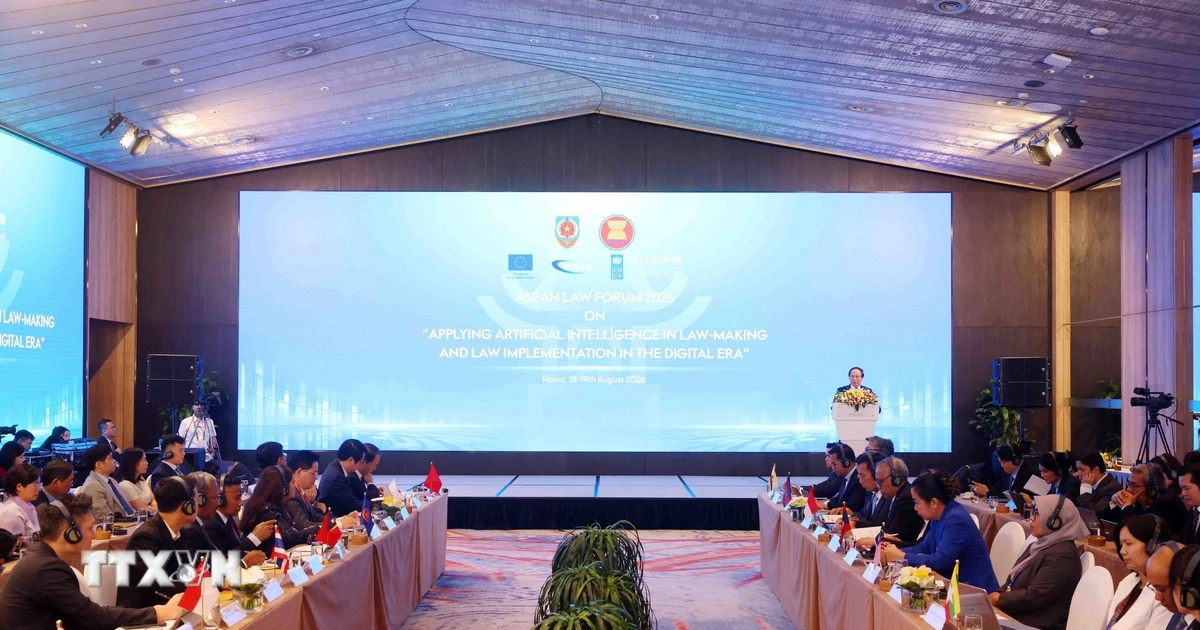
On the morning of August 18, in Hanoi, the Ministry of Justice of Vietnam organized the 2026 ASEAN Law Forum with the theme "Application of Artificial Intelligence (AI) in law-making and law enforcement in the digital era."
The forum takes place over two days (August 18-19).
Attendees at the Forum included: the Secretary of State of the Ministry of Justice of the Kingdom of Cambodia; the Deputy Minister of Justice of the Philippines (the 2026 ASEAN Chair); leaders, senior officials, and legal experts from the Ministries of Justice, Ministries of Law, and Offices of the Attorney General of ASEAN member states; the ASEAN Secretariat; and representatives of international organizations and sponsors such as the Economic Research Institute for ASEAN and East Asia (ERIA), the European Union (EU), the United Nations Development Programme (UNDP), the Organisation for Economic Co-operation and Development (OECD), and the United Nations Children's Fund (UNICEF)...
Speaking at the Opening Session, Deputy Prime Minister Le Tien Chau emphasized that the world is undergoing a pivotal transformation. The rapid development of science, technology, artificial intelligence, and big data is opening up new horizons while simultaneously widening the gap between leading countries and those lagging in transformation.
In this context, we are facing a major paradox of the era: risks are increasing, but the room for breakthroughs is also expanding.
Over the past time, Vietnam has achieved some initial results. The National Assembly has passed the Law on Artificial Intelligence, making Vietnam one of the first countries to have a dedicated law in this field.
The Prime Minister has approved the Project on developing the National Law Portal for the 2026-2030 period, establishing a unified platform for accessing legal data.
The Prime Minister has directed the Ministry of Justice to accelerate the completion of the national legal database system and tools for applying artificial intelligence in a standardized manner, consistent with the national digital architecture framework.
With these results, Vietnam is shifting strongly from a "governance" mindset in legislation to an "adaptive" and development-oriented one; ensuring the flexibility of the legal system to fully exploit the potential of new technologies while upholding core principles, values, and ensuring security and system safety factors.
Affirming that Vietnam consistently values the central role of ASEAN in the region's digital legal cooperation process, the Deputy Prime Minister stated that principles, standards, and norms for applying artificial intelligence in the legal and judicial fields should be formed first within ASEAN, led by ASEAN, based on consensus and respect for the sovereignty of each member state.

"Entering the second year of the journey to implement the ASEAN Community Vision 2045, I believe that ASEAN has the conditions to become a global pioneer in the responsible application of artificial intelligence in the legal and judicial fields, thereby contributing its voice to regional and global artificial intelligence governance frameworks," the Deputy Prime Minister shared.
Furthermore, ASEAN has a young population, one of the fastest digital transformation rates in the world, and a diversity of legal systems - this very diversity, if connected, will become one of the world's richest policy laboratories.
The Deputy Prime Minister called on ASEAN member states, development partners, and international organizations to join hands in implementing four major cooperation directions.
First, cooperate to develop a common set of principles for applying artificial intelligence in law-making and law enforcement based on inheriting the ASEAN Guide on AI Governance and Ethics.
Second, share legal data standards, norms, and experiences in digitization and reviewing legal normative document systems, moving towards more convenient legal research and comparison between ASEAN countries, thereby reducing compliance costs for citizens and businesses.
Third, cooperate to develop high-quality human resources in the judicial and legal fields, ensuring they are both knowledgeable in law and proficient in technology; support each other in data infrastructure and technology transfer, prioritizing members with difficulties. Thereby, gradually narrowing the digital capacity gap between member states so that no country and no one is left behind.
Fourth, maintain dialogue mechanisms, strengthen cooperation in sharing experiences, and connect networks of experts in the judicial and legal fields.
"Vietnam is committed to continuing as a responsible member; actively and proactively supporting regional and international cooperation initiatives; ready to share experiences, while also wishing to learn from the good, creative, and effective practices of members and international partners," the Deputy Prime Minister said.
At the Forum, Minister of Justice Hoang Thanh Tung stated that in Vietnam, building and perfecting institutions is always identified as one of the strategic breakthroughs for national development.
For the Justice sector, digital transformation is not just about digitizing the process of drafting legal normative documents or building legal databases, but more importantly, it is about innovating the method of law-making, improving the effectiveness of law enforcement, and enhancing the ability to serve citizens and businesses with modern technological tools.
In that process, AI is opening up very notable prospects but also bringing some common challenges that Vietnam and many countries are facing.

These are issues regarding personal data protection, cybersecurity, accountability of AI systems, algorithm transparency... AI has no borders, which requires legal and judicial agencies to strengthen international cooperation, share experiences, and jointly build approaches that are compatible, respect differences, but still aim for common values.
The Ministry of Justice of Vietnam is strongly committed to creating an open, safe, and synchronized legal environment, ready to accompany ministries, sectors, legal and judicial agencies of ASEAN countries, the ASEAN Secretariat, international organizations, the business community, and academia to strengthen experience exchange, promote professional cooperation, share knowledge, and jointly research and propose legal solutions suitable for the rapid development of artificial intelligence.
At the Plenary Session, delegates focused on discussing the following contents: Application of AI in law-making and perfection in Vietnam: current status, challenges, and prospects; Application of AI in developing the National Law Portal: Improving accessibility, research, and support for law enforcement in the digital era; Legal and policy frameworks of ASEAN countries on digital transformation and AI application in law-making and enforcement; Experience in applying AI to support citizens and businesses in accessing the law; Models and best practices for AI application in law-making and enforcement; Directions for strengthening cooperation between ASEAN legal and judicial agencies in the field of digital transformation and AI application; Models and best practices for Responsible Artificial Intelligence: European experience.
At the Thematic Session, content focused on the following topics: Exploiting artificial intelligence for smart governance: Opportunities and challenges for ASEAN; Directions for national sovereignty over artificial intelligence (AI) and cooperative governance in the public sector of ASEAN; Human-centric approach in artificial intelligence application: International experience./.

Improving the quality of law-making and law enforcement
The Government focuses on improving the process of law-making and law enforcement, reducing administrative procedures, and promoting the application of technology in legal management.
(VNA/Vietnam+)
Bài viết được AI dịch và tổng hợp tự động từ VietnamPlus Công nghệ. Liên kết bài gốc ở phía trên. AIHOT.vn luôn dẫn nguồn đầy đủ — nếu bạn thấy điểm cần chỉnh sửa, hãy gửi ý kiến tại trang phản hồi.