Tin ngành
Nghị quyết 57-NQ/TW: Đòn bẩy chiến lược thúc đẩy hệ sinh thái AI Việt Nam
(giờ Việt Nam)
Tóm tắt AI
Bài viết phân tích kết quả 18 tháng thực hiện Nghị quyết 57, khẳng định vai trò then chốt của các đại học nghiên cứu công nghệ trong việc định hình và phát triển hệ sinh thái AI quốc gia.
Bản dịch AI
After 18 months of implementing Resolution No. 57-NQ/TW of the Politburo on breakthroughs in developing science, technology, innovation, and national digital transformation.
It can be affirmed that this is a policy decision paving the way for a new model of national development. Science, technology, innovation, and digital transformation are no longer the story of a single industry or sector, but are gradually becoming the overarching driving force in national governance, economic development, improving the quality of life for the people, ensuring national defense and security, and expanding international cooperation.
The most prominent highlight after 18 months is the strong shift in development mindset. If previously science, technology, innovation, and digital transformation were often viewed as supporting tools, they are now identified as top-priority breakthroughs, serving as the primary engine for developing modern productive forces, perfecting production relations, innovating national governance methods, and enhancing competitiveness.
Based on this awareness, the requirement is not just to issue policies, build platforms, or implement tasks, but to create new capabilities, new products, and concrete value for the country.
The national conference reviewing 18 months of implementing Resolution 57 was held in a hybrid format, connecting the central venue at Dien Hong Hall, the National Assembly House, to 3,662 locations across ministries, agencies, sectors, localities, and units, with a total of over 568,380 delegates in attendance.
This scale demonstrates the synchronized involvement of the entire political system, while affirming the exceptionally important nature of the Resolution in the new development phase.
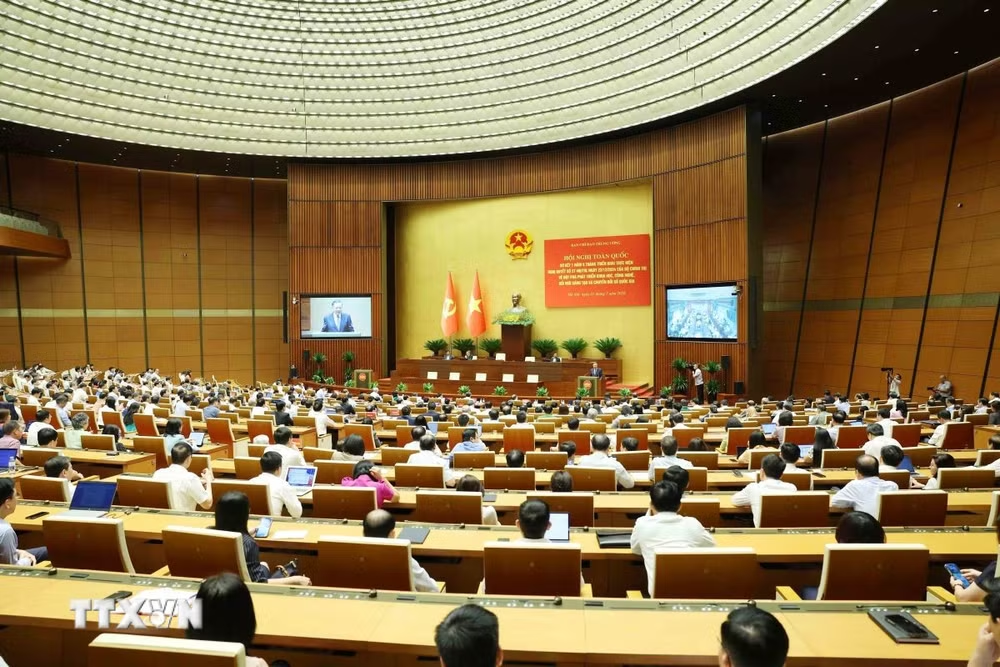
Guiding message: Substantive, effective, and measurable by products.
Delivering his keynote address at the conference, General Secretary and President To Lam emphasized that the implementation of Resolution 57 must be more determined, more vigorous, and must not be delayed; but more importantly, it must be more substantive and effective.
This is a highly significant guiding highlight: after the initial phase, the yardstick for the Resolution cannot simply be the number of documents issued, tasks registered, or systems deployed, but must be concrete products, practical value, and the level of change felt in governance, production, business, and the lives of the people.
This message shifts the focus of implementing the Resolution from "doing it for the sake of progress" to "doing it to build national capacity." Each level and sector must respond with results: what technology has been mastered, what data has been connected, what procedures have been cut, how much social cost has been saved, and what additional productivity, quality, and added value have been created for the economy.
This is also a requirement to form a new implementation culture: respecting data, valuing final efficiency, and putting people and businesses at the center.
The directive from General Secretary and President To Lam also sets out very clear responsibilities for heads of agencies. Science, technology, innovation, and digital transformation are no longer the sole responsibility of a specialized agency but are a central political task, measured by data, products, and the satisfaction of the people and businesses.
Places that perform well must be replicated; places that are formalistic, slow, or evasive must be reminded and reviewed; those who dare to think and dare to act for the common good must be encouraged and protected.
Institutions are moving strongly, national governance is shifting to a data-driven mindset.
One of the clearest results after 18 months is that the institutionalization process has been carried out urgently and decisively.
According to the report in the review documents, after Resolution 57 was issued, the Government strongly directed the completion of institutions and policies; competent authorities have issued 6 laws, 5 decrees, 3 resolutions, 3 decisions, and many documents to unlock resources and create a foundation for implementation.
This is an important shift, because in the field of science, technology, and innovation, institutions are not just management tools, but must also become a competitive advantage.
Along with that, the construction of national shared digital platforms continues to be promoted. Decision No. 1132/QĐ-TTg dated June 24, 2026, on criteria and the list of national shared digital platforms in agencies within the political system sets the requirement that shared digital platforms must be maintained, operated, and upgraded regularly, while limiting the overlapping investment in systems and software with similar functions.
This is an important basis for promoting e-Government, digital administration, and data-driven public governance.
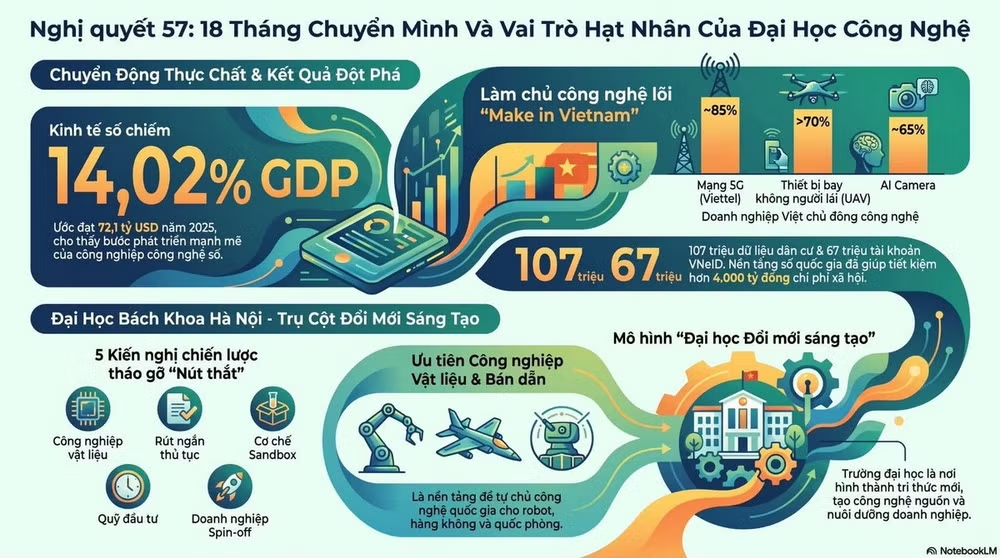
In administrative reform, Project 06 continues to be a prominent bright spot. The National Population Database now contains 107 million citizen records, connected to 15 ministries, sectors, and 34 localities, having received 2.1 billion authentication requests.
The VNeID application has 67 million electronic identification accounts, integrating 50 utilities. The National Public Service Portal integrates 4,700 procedures, receiving 11.5 million online applications in 2025, contributing to saving over 4 trillion VND in social costs.
These figures show that digital transformation is directly changing the way people and businesses are served.
Digital economy and technological self-reliance capacity have made new progress.
In the economic sector, Resolution 57 has created further momentum for the digital economy, digital technology industry, and science and technology enterprises to develop.
Cumulatively, as of the end of May 2026, the country has 963 science and technology enterprises, 20 science and technology trading floors, and 37 innovation centers in 26/34 provinces and cities. The rate of full-process online applications for the month reached 50.2%.
Notably, the proportion of value-added in the digital economy in 2025 is estimated to reach 14.02% of GDP, equivalent to approximately 72.1 billion USD. Significantly, many Vietnamese enterprises have begun to shift from applying technology to mastering core technology.
In the field of AI cameras, enterprises such as MK, Hanet, BKAV, CMC, and VNPT have mastered about 65% of the core technology, with a localization rate of over 50%.
Viettel has mastered about 85% of the core 5G network technology and developed high-tech defense products. The group of UAV developers such as Realtime Robotics, Viettel, and CT Group have mastered over 70% of the core technology, having invested in manufacturing plant complexes in Vietnam and initially exporting to the United States.
These are positive signals showing that Vietnam's technological self-reliance capacity is gradually taking shape, especially in fields capable of creating high added value and directly linked to economic security, data security, and national defense security.
Digital infrastructure is also developing rapidly. Reports at the meeting of the Government Steering Committee on developing science, technology, innovation, digital transformation, and Project 06 show that the 5G network coverage rate by population has reached 91.9%, with over 22.4 million subscribers; many large data centers have been started and inaugurated; and more than 4,200 GPU processors have been invested to serve artificial intelligence.
Along with that, Vietnam has identified a list of strategic technologies and strategic technology products including 11 technology groups with 35 product groups, including artificial intelligence, cloud computing, quantum, big data, blockchain, 5G/6G, robotics and automation, semiconductor chips, advanced biotechnology, advanced energy and materials, rare earths, cybersecurity, and aerospace.
Hanoi University of Science and Technology: The nucleus for training, research, and technology commercialization in implementing Resolution 57.
In that overall picture, the role of research universities, especially leading technical-technological universities, needs to be recognized as a strategic pillar.
If the State is the entity that creates institutions, and enterprises are the force that brings technology to the market, then universities are where new knowledge is formed, high-quality human resources are trained, source technology is created, and research groups capable of developing into technology enterprises are nurtured.
With its position as the leading technology university in Vietnam, Hanoi University of Science and Technology plays an especially important role in realizing Resolution 57.
From the requirement of being "substantive, effective, and measurable by products," the role of Hanoi University of Science and Technology becomes even more prominent.
For Resolution 57 to go into depth, Vietnam cannot just stop at importing equipment, buying software, or applying existing technology, but must form the capacity for research, design, manufacturing, testing, standardization, transfer, and commercialization of technology right within the country.
Hanoi University of Science and Technology is one of the institutions with the capacity to undertake this role, especially in strategic technology fields such as materials, semiconductors, AI, robotics, automation, new energy, aerospace, and cybersecurity.
Bài viết được AI dịch và tổng hợp tự động từ VietnamPlus Công nghệ. Liên kết bài gốc ở phía trên. AIHOT.vn luôn dẫn nguồn đầy đủ — nếu bạn thấy điểm cần chỉnh sửa, hãy gửi ý kiến tại trang phản hồi.