Tin ngành
Tổng Bí thư, Chủ tịch nước Tô Lâm: Ưu tiên nguồn lực phát triển AI, robot và chip bán dẫn
(giờ Việt Nam)
Tóm tắt AI
Tổng Bí thư, Chủ tịch nước Tô Lâm chỉ đạo tập trung nguồn lực để làm chủ và thương mại hóa các công nghệ chiến lược như AI, robot, UAV và chip bán dẫn nhằm thúc đẩy kinh tế số.
Bản dịch AI
General Secretary and President To Lam has requested a focus on resources to master and develop strategic technologies into concrete products, especially in AI, robotics, UAVs, and semiconductors.
This content was stated in Notice No. 24 of the Standing Body of the Central Steering Committee for Science, Technology, Innovation, and Digital Transformation regarding the conclusions of General Secretary and President To Lam at the National Conference reviewing 1.5 years of implementing Resolution 57.
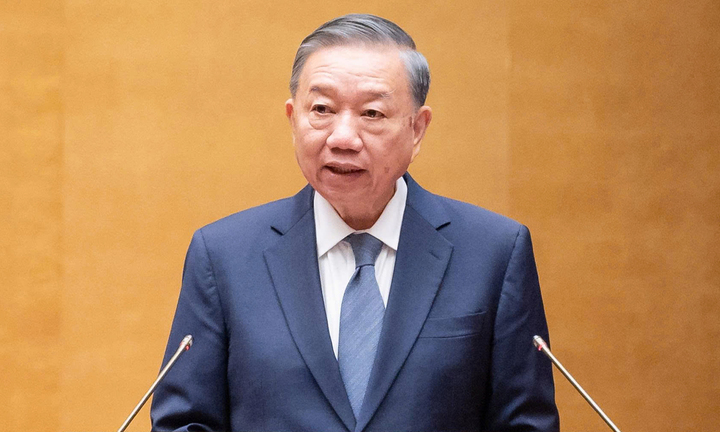
General Secretary and President To Lam.
Focusing resources on developing AI, robotics, and UAVs.
The General Secretary and President noted that science, technology, innovation, and digital transformation are identified as the primary drivers for reforming development models, enhancing productivity, competitiveness, governance efficiency, and national self-reliance. Institutions, mechanisms, and policies are being gradually perfected; many bottlenecks and obstacles have been reviewed and removed.
Vietnam has identified 10 strategic technologies associated with 30 strategic technology products and 20 major national challenges. Several domestic enterprises are gradually mastering technology and developing products for both the domestic and export markets.
However, the General Secretary and President assessed that there are still many limitations regarding institutions, infrastructure, human resources, data, cybersecurity, information security, and capital disbursement. Practical results are not yet commensurate with the resources and political determination, and have not yet generated many concrete strategic products.
"The weakest link currently is implementation; under the same conditions, where implementation is decisive and the head directly directs, concrete products and results are created; where implementation is formalistic and delayed, and the head does not fully exercise their responsibility in leadership, direction, and enforcement discipline, progress remains limited," the conclusion stated.
The General Secretary and President requested that agencies and units deeply recognize that science, technology, innovation, and digital transformation are the primary drivers for reforming development models and establishing new growth models; they are the inevitable path to realizing the country's two 100-year goals.
In the context of increasingly fierce technological competition, the implementation of Resolution 57 is not only aimed at overcoming the risk of falling behind but also directly contributes to enhancing strategic self-reliance, ensuring national defense, security, and national sovereignty.
The General Secretary and President emphasized that tasks under Resolution 57 are only considered complete when there are operational products, verified data, actual users, and measurable effectiveness.
Implementation results should not stop at the issuance of documents, the creation of plans, the organization of conferences, or the establishment of apparatuses, but must be demonstrated by mastered technology, connected data, reduced and simplified administrative procedures, improved productivity, business development, benefits brought to the people and society, and contributions to growth.
"Focus resources on mastering and developing strategic technologies into concrete products, especially Artificial Intelligence (AI), big data, robotics and automation, biotechnology and biomedicine, materials and energy, semiconductors, cybersecurity, quantum technology, Unmanned Aerial Vehicles (UAVs), marine, ocean, and underground technology," the General Secretary and President assigned the task.
For each strategic technology, goals must be clearly defined according to 1-year, 3-year, 5-year, and 10-year milestones regarding mastered technology, formed products, export capacity, and contributions to growth, national defense, security, and national self-reliance. The ministry or agency assigned to lead is not only responsible for processes and procedures but must be responsible for the final product, results, effectiveness, and practical impact.
Agencies and units must pay special attention to ensuring cybersecurity, information security, data security, and national digital sovereignty; do not trade security and safety for development, but also do not let fear of risk slow down innovation.
According to the direction of the General Secretary and President, each locality must clearly identify practical problems that need to be solved by science, technology, innovation, and digital transformation; proactively register to take on major challenges, propose new mechanisms, models, and methods; and promptly report practical obstacles to propose that the Central Government amend and perfect institutions.
The business community is encouraged to increase investment in research and development (R&D), technological innovation, digital transformation, high-quality human resource training, and participation in national strategic technology programs, truly becoming the center of the innovation ecosystem.
Large state-owned and private corporations and enterprises must play a leading and pioneering role in mastering core technologies, developing Vietnamese technology products, participating deeply in global value chains, and forming innovation ecosystems with spillover effects.
To create a foundation of knowledge and human resources for the development of science, technology, innovation, and digital transformation, the General Secretary requested policies strong enough to attract and utilize talent, experts, and Vietnamese intellectuals both at home and abroad; forming strong research groups and effectively connecting the global Vietnamese intellectual network.
International cooperation must shift from a focus on attracting capital to attracting knowledge, technology, and experts, associated with enhancing domestic research, development, and technology mastery capabilities.
Starting from the 2026-2027 school year, the education and training sector, higher education institutions, and vocational education institutions must review training curricula, prioritizing strategic technology fields; promote the training of digital skills, innovation capacity, and AI application.
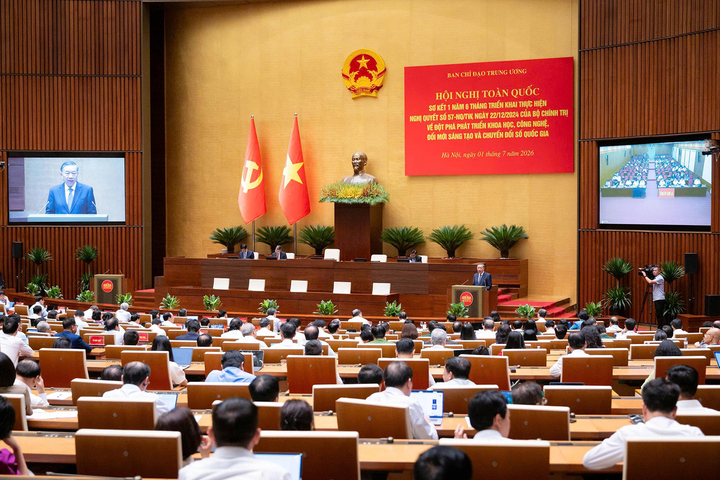
Scene of the National Conference reviewing 1.5 years of implementing Resolution 57.
Results of implementing Resolution 57 are criteria for evaluating officials.
Setting out key tasks for the coming time, the General Secretary and President requested a strong reform of leadership, direction, inspection, supervision, and evaluation of implementation results.
In particular, the heads of all levels must directly lead, direct, inspect, and take responsibility for the results of implementing Resolution 57 within their scope of responsibility. Tasks within their authority must be proactively resolved; tasks beyond their authority must be promptly reported and proposed to competent authorities for consideration and decision; do not wait, push, or avoid responsibility.
According to the orientation of the head of the Party and State, the results of implementing Resolution 57 must be identified as important criteria in evaluating officials, collectives, and heads.
Along with commending, rewarding, and replicating organizations and individuals that perform well and have concrete products and results, it is necessary to remind, review, and handle cases of formalistic implementation, delays, and avoidance of responsibility; encourage and protect officials who dare to think, dare to do, and dare to take responsibility for the common good.
"Party committees and party organizations at the central and local levels shall build plans for training, fostering, and preparing a pool of officials; implement the policy of increasing the percentage of officials with science and technology qualifications in party committees from 5% to 10-15%. Strictly implement the Politburo's regulations on quarterly evaluation of officials; promptly replace and transfer officials who do not meet requirements and tasks," the General Secretary and President instructed.
The Central Inspection Commission and inspection commissions at all levels are required to strengthen inspection and supervision of the leadership, direction, and implementation of Resolution 57; promptly detect, rectify, and handle manifestations of formalism, delays, and lack of responsibility, ensuring that guidelines and tasks are implemented seriously, substantively, and effectively.
Bài viết được AI dịch và tổng hợp tự động từ CafeF Kinh tế số. Liên kết bài gốc ở phía trên. AIHOT.vn luôn dẫn nguồn đầy đủ — nếu bạn thấy điểm cần chỉnh sửa, hãy gửi ý kiến tại trang phản hồi.