Tin ngành
Đà Nẵng tiên phong xây dựng hệ sinh thái kinh tế không gian tầm thấp
(giờ Việt Nam)
Tóm tắt AI
Đà Nẵng đang triển khai đề án phát triển kinh tế không gian tầm thấp đến năm 2030, tích hợp AI, hạ tầng số và logistics nhằm tạo động lực tăng trưởng mới cho thành phố.
Bản dịch AI

On September 8, 2026, the Da Nang City People's Committee organized a scientific seminar to develop the "Pilot Project for Developing Low-Altitude Economy in Da Nang City by 2030." The seminar focused on gathering feedback to refine the draft project, identifying application use cases, infrastructure, technology, and management mechanisms for the pilot implementation.
The development of this project is included in the implementation plan for Resolution No. 57-NQ/TW of the Politburo and has been approved by the Prime Minister via Official Dispatch No. 4392/VPCP-QHĐP dated May 14, 2026. The Da Nang Department of Science and Technology has been assigned to lead and coordinate with relevant agencies and experts to develop the project.
Opening new spaces for economic development
Da Nang possesses many advantages for researching and implementing a low-altitude economy, thanks to its diverse topography, ranging from urban areas, coastal zones, rivers, and islands to high-tech parks, seaports, airports, logistics hubs, and Free Trade Zones. The city also features mountainous and forested regions, as well as areas that are difficult to access during natural disasters, landslides, flash floods, or forest fires.
Alongside its geographical advantages, Da Nang is focusing on developing science and technology, particularly in semiconductor microchips, artificial intelligence (AI), and controlled experimental models. These serve as the foundation for exploring the potential of low-altitude space, creating new room for socio-economic activities.
Speaking at the seminar, Mr. Ho Quang Buu, Vice Chairman of the Da Nang City People's Committee, emphasized that low-altitude space should be viewed as a new socio-economic development frontier, requiring a synchronized integration of infrastructure, technology, and policy to contribute to the city's new growth momentum.
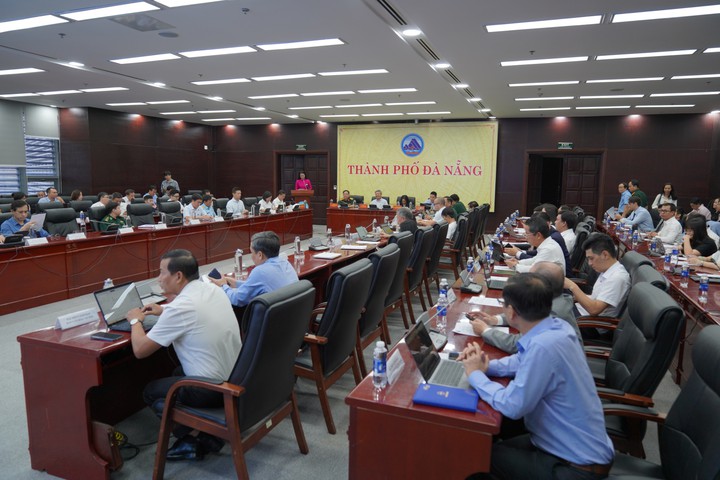
Overview of the seminar.
According to the draft project, the challenge is not merely to introduce Unmanned Aerial Vehicles (UAVs) into isolated sectors, but to gradually form an ecosystem involving the State, businesses, research institutes, universities, and technology stakeholders.
Low-altitude space below 1,000 meters is identified as a new resource that needs to be organized and exploited appropriately. The approach is built along a value chain from midstream to downstream, developing new services and business models based on UAVs, data, and technology platforms.
Along with development requirements, the city is paying special attention to technical issues, the division of roles between the State and the market, a controlled experimental mechanism (sandbox), and the highest level of security, defense, airspace sovereignty, and data safety.
Technology to solve practical problems
The pilot phase is expected to last 18 months, from late 2026 to early 2028. Da Nang aims to deploy at least 3 low-altitude flight services, attracting 5 companies to participate in flight operations and 10 companies to join the value chain. The pilot activities aim to reduce transportation time by an average of 40% and costs by 30%.
Priority sectors include logistics; tourism; healthcare, search and rescue; agriculture and forestry; and urban and environmental management. Testing activities will be organized in pre-planned flight zones, combined with the construction of shared technical and technological infrastructure such as Unmanned Traffic Management (UTM) systems, the Intelligent Operations Center (IOC), and inter-agency coordination mechanisms to ensure safety, security, and defense.
To operate this ecosystem, artificial intelligence (AI), 5G/6G mobile networks, 3D map data, and shared UTM systems are identified as critical technological components.
In practice, many applicable use cases have been identified, such as emergency medical transport, express delivery to island areas, forest monitoring and protection, disaster response, resource management, and identifying timber regions to comply with anti-deforestation regulations. Implementing these applications simultaneously requires appropriate data and technology platforms to protect sensitive information.
The controlled experimental mechanism (sandbox) is one of the key components of the project. Opinions at the seminar suggested that the sandbox should be designed to provide space for businesses to test technology while strictly controlling risks related to airspace, aviation safety, data, defense, and security.
A "Digital Approval" model was also proposed to gradually automate the management process for high-frequency, repetitive flights.
Regarding resources, the Public-Private Partnership (PPP) model is considered an appropriate approach. In this model, the State plays the role of institutional creator, building the testing environment and potentially becoming an "anchor customer" by ordering initial services, thereby helping to create a market for new products and services.
Building capacity for research, training, and UAV production
The project proposes 4 pilot areas including Son Tra ward, Ngu Hanh Son ward, Tam Ky ward, and Tien Phuoc commune, linked to needs such as tourism, delivery, urban management, search and rescue, emergency aid, and agriculture. Defining flight zones and routes based on actual needs aims to verify the effectiveness of each model before scaling up.
In addition to service and business goals, by early 2028, the city expects 5 universities to offer courses on the low-altitude economy. From 2028 onwards, Da Nang will expand its activities, gradually forming a low-altitude economic ecosystem.
The city is also preparing to deploy a research, production, training, and UAV testing center for the Central region, linked to the development of semiconductor microchips and artificial intelligence, serving both economic development and security and defense goals.

Da Nang will expand its activities, gradually forming a low-altitude economic ecosystem.
The project is expected to be evaluated in stages. After 6 months, a preliminary review of the first phase will be conducted, focusing on implementation results, effectiveness, licensing processes, and safe operation. After 12 months, the feasibility of services, application use cases, and socio-economic impact will be assessed. After 18 months, a comprehensive summary will be conducted to serve as a basis for policy refinement and the development of an official implementation plan.
The Da Nang Department of Science and Technology has been assigned to lead the review of priority services, determine the public-private investment allocation model, and promote the participation of businesses, research institutes, and universities in research and technology transfer.
According to the city's orientation, the low-altitude economy will be implemented under an "open but controlled" model, creating conditions for innovation while ensuring harmony between economic development and national defense and security.
Through the pilot phase, Da Nang aims to gradually build capacity in research, training, production, testing, and UAV application; promoting technological mastery and the development of new products and services. This serves as the basis for the city to become a regional hub for innovation, research, and high-quality human resource training in the low-altitude economy, forming a comprehensive ecosystem by 2030 that is safe, effective, and sustainable.
Bài viết được AI dịch và tổng hợp tự động từ Bộ KH&CN. Liên kết bài gốc ở phía trên. AIHOT.vn luôn dẫn nguồn đầy đủ — nếu bạn thấy điểm cần chỉnh sửa, hãy gửi ý kiến tại trang phản hồi.