Tin ngành
Việt Nam và Nga đẩy mạnh hợp tác chiến lược trong lĩnh vực công nghệ cao
(giờ Việt Nam)
Tóm tắt AI
Tại diễn đàn ngày 9/9/2026, Việt Nam và Nga đã thống nhất thúc đẩy hợp tác sâu rộng trong các lĩnh vực mũi nhọn như AI, bán dẫn, công nghệ lượng tử và năng lượng mới.
Bản dịch AI
From traditional cooperation platforms to strategic technology
Delivering the opening remarks at the Forum, Deputy Prime Minister of the Russian Federation Dmitry Chernyshenko affirmed that Vietnam has long been a trusted partner of the Russian Federation. The traditional friendship between the two countries is increasingly expanding across many fields, in which science, technology, and education are key areas of cooperation.
In 2026, the two countries agreed to organize the Year of Education, Science, and Technology Exchange in accordance with the Joint Statement. According to Deputy Prime Minister Dmitry Chernyshenko, this is an opportunity for Vietnam and the Russian Federation to promote new cooperation programs, especially in high-tech sectors.

Russian Deputy Prime Minister Dmitry Chernyshenko speaking.
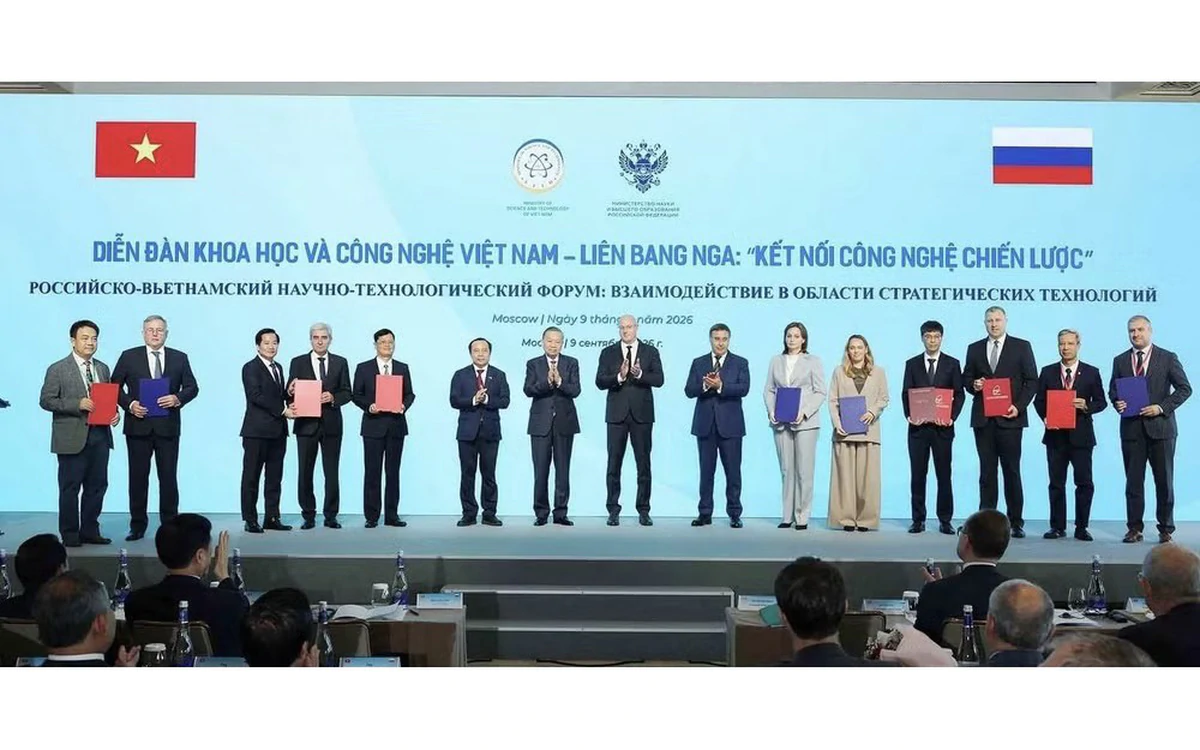
Within the framework of the Forum, the two sides launched the selection of new joint research projects organized by the Russian Science Foundation and the National Foundation for Science and Technology Development of Vietnam; at the same time, they announced and initiated several other cooperation projects.
Assessing that AI, advanced materials, new materials, new energy, and space technology are fields capable of shaping the future technological landscape, Deputy Prime Minister Dmitry Chernyshenko suggested that Vietnam-Russia cooperation needs to shift strongly from sharing achievements to combining research capabilities, technology, and resources of both sides to jointly create advanced products and solutions.
Accordingly, scientific and technological cooperation is expected to continue to be an important driving force for the comprehensive, deep, substantive, and effective development of the Vietnam-Russian Federation Comprehensive Strategic Partnership.
A new stature needed for scientific and technological cooperation
Delivering the introductory speech, Minister of Science and Technology Vu Hai Quan emphasized that science, technology, education, and training have long been pillars of the traditional friendship and Comprehensive Strategic Partnership between Vietnam and the Russian Federation.
Over many decades, tens of thousands of Vietnamese officials, scientists, and experts were trained in the former Soviet Union and the modern-day Russian Federation. This force has become an important human resource, contributing to the process of national construction and development.
According to Minister Vu Hai Quan, in the face of new development requirements, Vietnam-Russia scientific and technological cooperation needs to be elevated to a new height. The theme "Connecting Strategic Technology" of the Vietnam-Russian Federation Science and Technology Forum reflects the orientation of shifting from exchange and sharing to joint research, joint mastery of technology, and joint creation of valuable products.
Vietnam has a great demand for receiving, mastering, and developing core and strategic technologies. Meanwhile, the Russian Federation has strengths in basic science and many advanced technological fields such as nuclear technology, quantum technology, new materials, and information security. Combining Russia's research potential with Vietnam's development needs, innovation capacity, and market is expected to create new room for cooperation.

Minister of Science and Technology Vu Hai Quan speaking.
One of the directions being promoted by the two countries is expanding the joint research funding program to strategic technology fields. In 2026, the two countries selected 4 topics for funding out of 34 submitted proposals, a significant increase compared to the previous period.
The two countries also plan to hold a session of the Joint Committee on Science and Technology at the end of November 2026 to focus on discussing strategic technology, quantum technology, and the orientation for establishing a Strategic Technology Research Center.
Along with that, the young scientist exchange program continues to be expanded. It is expected that at least 30-50 young Vietnamese scientists will participate in the Young Scientists Conference in early December 2026; at the same time, both sides are also studying and expanding support for doctoral scholarships in strategic technology majors.
In the field of atomic energy, the Ministry of Science and Technology of Vietnam is coordinating with the Russian State Corporation Rosatom to resolve obstacles related to the cooperation in building the Nuclear Science and Technology Research Center. Vietnam has also completed training for 10 experts in nuclear power plant site appraisal and reached an agreement for the Vietnam Atomic Energy Institute to join the joint venture of Rosatom's International Research Center.
According to Minister Vu Hai Quan, future cooperation needs to focus on 3 contents:
(1) Selecting strategic technologies with complementary strengths;
(2) Forming in-depth research and development cooperation models;
(3) Linking scientific research with human resource training, enterprises, and the market.
Shifting cooperation from documents to technology, products, and markets
Delivering the directive speech at the Forum, General Secretary and President To Lam emphasized that Vietnam is entering a new stage of development, in which science, technology, innovation, and digital transformation are identified as the main drivers to renew the growth model, improve labor productivity, competitiveness, and the autonomy of the economy, in the spirit of Resolution No. 57-NQ/TW dated December 22, 2024, of the Politburo.
Vietnam values international cooperation, especially with partners that have a strong scientific and technological foundation, a traditional friendship, and the ability to complement Vietnam's development needs. The Russian Federation is one of those important partners.
According to the General Secretary and President, science, technology, and education have created an important foundation in Vietnam-Russia relations. In the new stage, the two countries need to bring this cooperation foundation to develop in accordance with the requirements of the era.
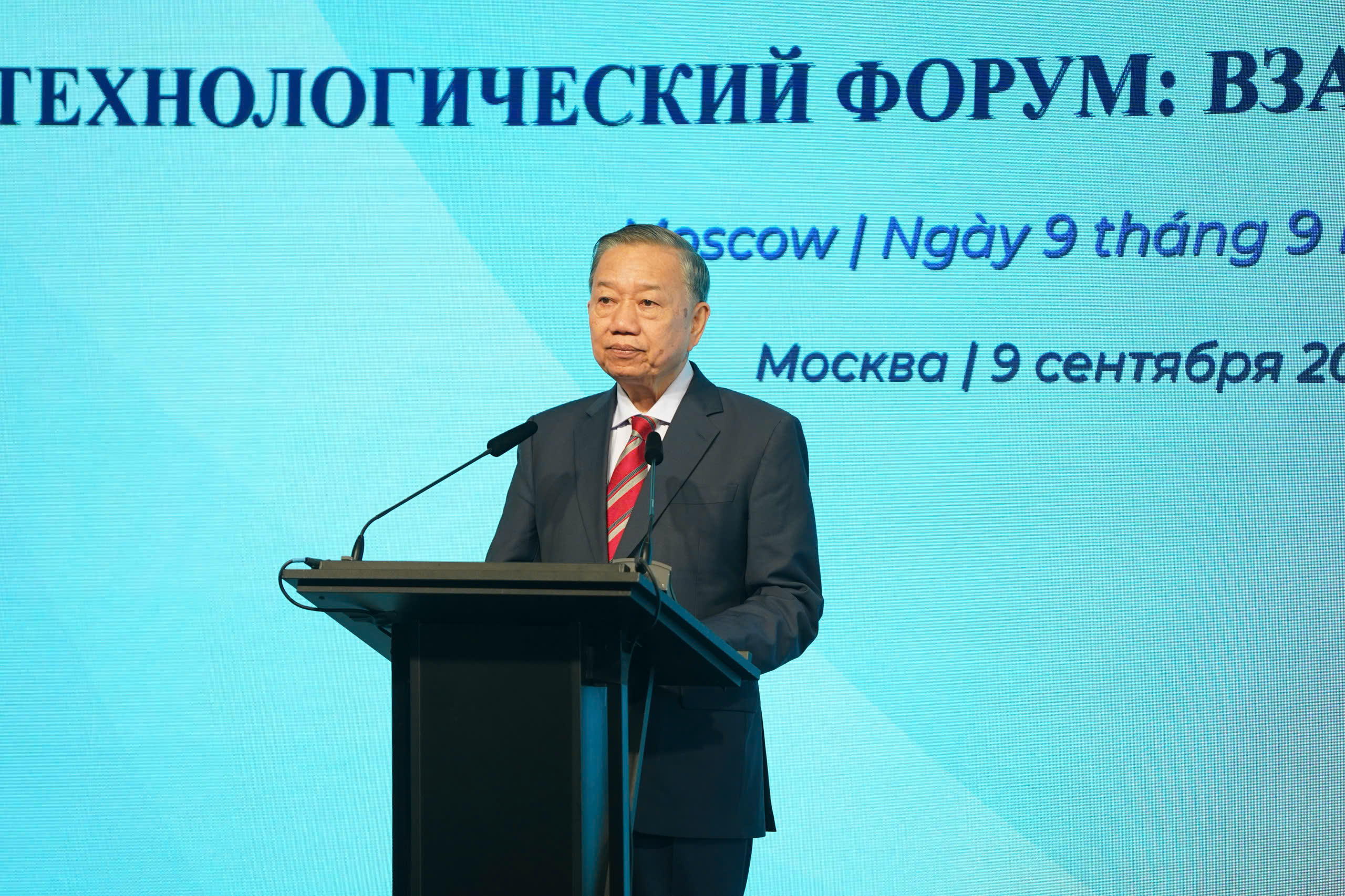
General Secretary and President To Lam speaking at the Forum.
"Vietnam-Russian Federation scientific and technological cooperation in the coming period needs a new mindset, new ways of doing things, and higher goals," the General Secretary and President stated clearly.
Accordingly, cooperation should not stop at exchanging experts and training officials but needs to aim at jointly mastering technology, jointly creating products, and jointly participating in the market.
To realize this goal, General Secretary and President To Lam suggested that both sides focus on 5 major orientations:
First, make strategic technology cooperation a new important pillar in the Vietnam-Russian Federation Comprehensive Strategic Partnership.
Both sides need to select a number of strategic fields, combining Russia's scientific and technological strengths with Vietnam's development needs, human resources, and market. Priority fields include atomic energy, new energy, space technology, satellites, semiconductors, microelectronics, quantum technology, and AI.
Second, both sides also need to build large-scale scientific and technological programs and projects that are symbolic of the new cooperation stage; study the formation of joint centers, laboratories, and projects with the participation of research institutes, universities, and enterprises of both countries.
Third, make enterprises the central subject of scientific, technological, and innovation cooperation.
According to the General Secretary and President, scientific research only truly creates development power when the results are transformed into technology, products, and production capacity.
Vietnam hopes that Russian technology and energy corporations will increase investment and technology transfer in Vietnam; at the same time, it encourages Vietnamese technology enterprises to seek investment and cooperation opportunities in Russia.
Fourth, the two countries need to dedicate resources to the generation of young scientists and experts.
Bài viết được AI dịch và tổng hợp tự động từ Bộ KH&CN. Liên kết bài gốc ở phía trên. AIHOT.vn luôn dẫn nguồn đầy đủ — nếu bạn thấy điểm cần chỉnh sửa, hãy gửi ý kiến tại trang phản hồi.