Tin ngành
Cảnh báo bẫy tin giả tinh vi trong kỷ nguyên AI
(giờ Việt Nam)
Tóm tắt AI
Công nghệ AI tạo sinh đang khiến tin giả trở nên chân thực hơn bao giờ hết, kết hợp cùng thuật toán mạng xã hội tạo ra nguy cơ lan truyền thông tin sai lệch với tốc độ chóng mặt.
Bản dịch AI
AI technology helps create hyper-realistic images, videos, and information. Combined with social media algorithms, fake news can spread in just a short amount of time.
The fake news matrix from artificial intelligence
The boom of artificial intelligence is bringing about a dangerous threat, trapping users in a matrix of fake news. As AI technology becomes increasingly accessible, bad actors only need a few clicks to fabricate countless images, videos, and false information. Hidden under various sophisticated guises, these contents set traps to manipulate psychology by inciting outrage or sympathy, making users easily drop their guard and ultimately fall into the fake news trap.
Using AI tools, bad actors have fabricated information about catastrophic accidents involving casualties among traffic police. To increase authenticity, these subjects also add fake locations, times, and details to their posts. In a short time, a series of accounts simultaneously report the news, creating an information matrix that leads many to mistake it for a real event.
"These posts stem from the goal of inciting emotional outrage, wanting others to share the post immediately without thinking. And usually, this information travels very far and very fast," said Mr. Bui Minh Hop from Phu Tho province.
As AI technology and deepfakes explode, fake content is becoming increasingly sophisticated. A series of AI-generated videos easily attract hundreds of thousands of views just hours after being posted. Bad actors not only fabricate tragic images to scam for donations but also impersonate the faces of celebrities, creating videos that look exactly like the real thing to facilitate deceptive advertising schemes.

Fake news is being created with increasing sophistication thanks to AI and spread powerfully by platform algorithms.
MSc. Ngo Van Truong, Lecturer at the Faculty of Political Science, Vietnam Youth Academy, assessed: "AI technology makes the dissemination of information easier, and young people are often attracted to sensational news involving authorities or famous figures. These pieces of news are exploited to cause psychological panic among the general public."
According to recent statistics, in just one year, the number of phishing attacks using AI has increased about 20 times. This alarming figure shows that as technology gradually blurs the line between truth and falsehood, anyone can become the next victim of the fake news matrix.
When platform algorithms are exploited to spread fake news
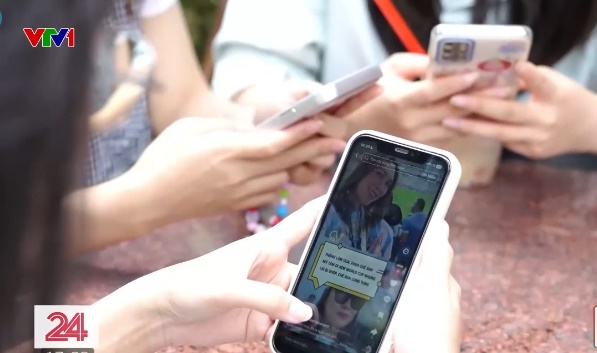
Only by verifying information before sharing can users avoid traps in cyberspace.
Fake news can be easily created by AI, but the catalyst that makes it spread rapidly is the platforms' algorithms. Social media platform algorithms constantly record user behavior to continuously distribute content with characteristics similar to what they have viewed before. Once users are continuously exposed to one-sided content, they may believe it is the whole truth.
This phenomenon can be likened to an "information echo chamber," where users are locked in a closed information space, where similar viewpoints are constantly echoed, amplified, and reinforced, while opposing information is gradually pushed out. This mechanism is easily exploited by malicious forces through systems of virtual accounts to amplify fake news and manipulate user psychology.
Just a tap, a search, or even a few seconds of pausing before a video... every behavior in cyberspace is recorded by digital platforms. Behind those seemingly harmless screens is a "matrix of algorithms" silently guiding the information that users access every day.
"From our psychological perspective, we can call it the user's psychological profile. Each of us leaves traces in the cyberspace environment, and subjects can use them to build individual profiles to access fake news, sensational news, shocking news, or even information aimed at changing our perceptions in the most sophisticated way possible," shared Lieutenant Colonel, Dr. Bui Thi Lien from the People's Security Academy.
The "information echo chamber" not only makes the information that network users access increasingly narrow but also increases the trend of radicalization. When accustomed to hearing viewpoints similar to their own, users will reduce their ability to empathize with different perspectives.
Mr. Nguyen Dinh Thanh, Deputy General Director of the Digital Communications and Technology Company (NetSpace), commented: "Those who create fake news are actually people who are very knowledgeable about media, making many people believe and follow what the creators of that fake news recommend - that is very dangerous. It is not just about factual errors, but also has economic, political, and even deeper social impacts."
According to Mr. Vu Ngoc Son, Director of the Technology and International Cooperation Department, Vietnam National Cybersecurity Association: "In cyberspace, if it is not controlled and someone manipulates this information, it is clear that a person's perception will be significantly affected. In particular, negative and misleading information can affect positive, official information."
It is worrying that currently, virtual accounts, automated systems, and content distribution technology can cause fake news and misinformation to spread at a rapid speed. Hundreds or thousands of virtual accounts can simultaneously share, comment, and amplify a piece of information. When users confuse "what is talked about by many" with "the truth," that is when they have fallen into the algorithm's trap.
According to the handbook on preventing fake news and misinformation in cyberspace by the Authority of Broadcasting and Electronic Information, Ministry of Culture, Sports and Tourism, there are 4 common types of fake news:
- Commercial fake news: Fabricating information for economic purposes, creating virtual fevers to scam and make money.
- Political fake news: Cutting, splicing, and distorting information to smear Party and State leaders and oppose the regime.
- Social life fake news: Distorting hot events to "bait likes" or live virtually because of a desire for fame or to serve online business.
- Satirical, humorous fake news: Intended only for entertainment.
To avoid becoming a victim, when you see suspicious information, apply the following steps to verify:
- Check the source of the news, check the author.
- Check the information, illustrative images, and links.
- Check the date and time of posting.
- Read the entire content, look for suspicious points and contradictions.
- Compare with information in official media or consult authorities.
"Slow down a beat" to recognize fake news
However, in the matrix of information, the easiest "golden" rule to remember is: "Slow down a beat." Don't rush to believe, don't rush to share. A few seconds of slowing down can be a shield to protect you in cyberspace.
Mr. Lo Van Quang (Son La) believes: "To limit the spread of fake news, first of all, everyone needs to receive information with a clear head and proactively verify it before believing. If the information has not been verified or the source is unclear, do not share or interact, to avoid accidentally causing that content to spread on social media. For information identified as fake, users should report it so that platforms can remove it in a timely manner."
Lieutenant Colonel, Dr. Bui Thi Lien from the People's Security Academy said: "Currently, sanctions for spreading fake news are becoming increasingly strict. This is both a deterrent and a reminder that every citizen must be responsible for all the information they post, as well as carefully consider before sharing any content in cyberspace."
"Vietnam is implementing many programs and campaigns to raise awareness about information security for people of all ages. This is a very important factor, especially in the context of AI models developed from data. Everyone needs to know how to protect their personal information and data to minimize the risks of scams and insecurity in the digital environment," shared Mr. Ngo Minh Hieu, Director of the Anti-Scam Project.
Bài viết được AI dịch và tổng hợp tự động từ CafeF Kinh tế số. Liên kết bài gốc ở phía trên. AIHOT.vn luôn dẫn nguồn đầy đủ — nếu bạn thấy điểm cần chỉnh sửa, hãy gửi ý kiến tại trang phản hồi.