Tin ngành
Ứng dụng AI dựng bản đồ não 3D hỗ trợ robot phẫu thuật đột quỵ
(giờ Việt Nam)
Tóm tắt AI
Các bác sĩ sử dụng công nghệ AI để dựng mô hình não 3D, giúp robot dẫn đường dao mổ chính xác trong quá trình điều trị xuất huyết não cho bệnh nhân.
Bản dịch AI
Tuesday, September 22, 2026, 08:00 (GMT+7)
AI maps the brain for stroke-treating robots
Mr. Ha, 52, suffered a brain hemorrhage. Doctors used an AI-powered robot to build a 3D brain model to plan the surgery and guide the surgical instruments, ensuring precise maneuvers.
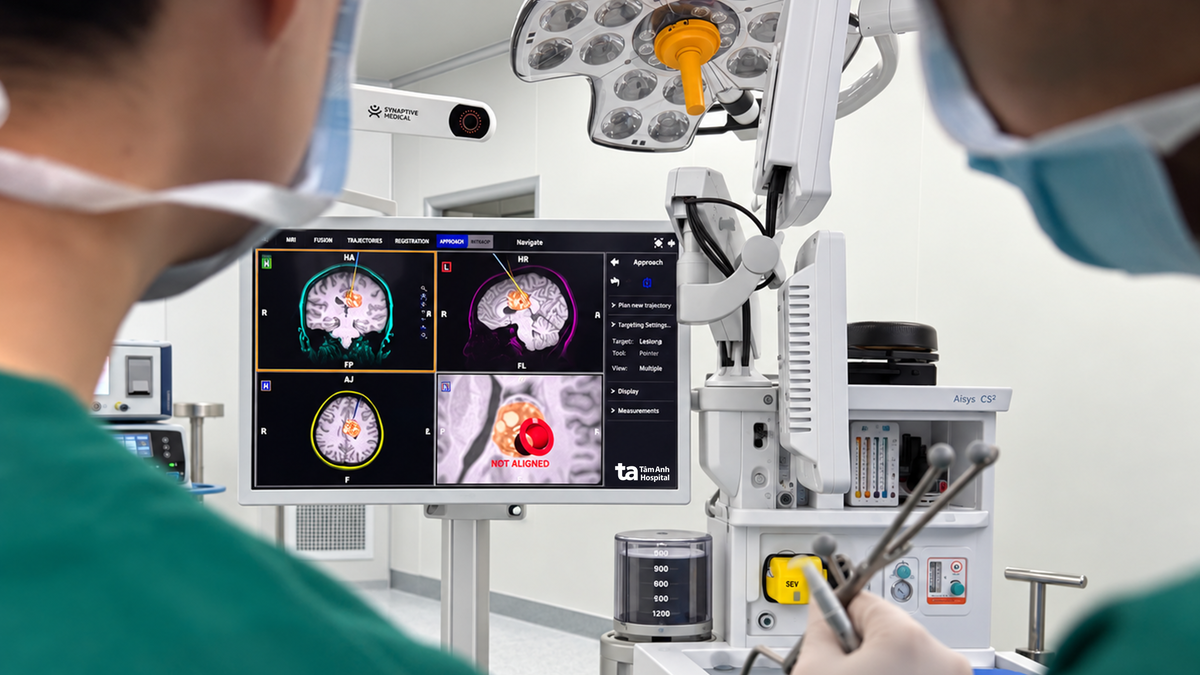
He was admitted to the emergency department at Tam Anh General Hospital with severely reduced consciousness and left-sided hemiplegia. Before surgery, imaging data of Mr. Ha's brain was fed into the specialized software of the Modus V Synaptive robot, which used artificial intelligence (AI) to create a sharp 3D brain model.
On this "3D brain," Meritorious Doctor, MSc.BS.CKII Chu Tan Si, Head of the Department of Neurosurgery - Spine, Neuroscience Center, Tam Anh General Hospital in Ho Chi Minh City, and his team evaluated factors such as the location and size of the hematoma, the damaged brain area, and the pathways of surrounding nerve fiber bundles, thereby determining a suitable and safe approach to remove the hematoma.
The system recorded a hematoma of approximately 80 ml in the right lentiform nucleus. The lentiform nucleus is located deep within the brain, near critical nerve pathways. Doctors assessed that traditional brain surgery could not intervene effectively. Instead, the team applied the AI robot with a minimally invasive surgical technique, creating a 1.5-3 cm diameter access port for the surgical instrument to pass through, running parallel to the nerve fiber bundles and acting as a surgical corridor. This technique helps doctors access and remove the hematoma more easily and safely.


Dr. Tan Si builds a 3D brain map on the AI-integrated software of the Modus V Synaptive robot (left photo).
The doctor "registers" the patient with the AI robot's navigation system, synchronizing it with the surgical plan previously prepared on the "3D brain" (right photo).
The role of AI is to help the robotic arm with spatial orientation and guide the surgical instrument to follow the plan established on the "3D brain." If the maneuver deviates from the safe corridor, the navigation system immediately issues a warning. The robot's AI also supports automatic camera and lighting control, maintaining stable images in deep, hard-to-reach areas.
Immediately after surgery, Mr. Ha regained consciousness, and his awareness improved significantly. He was discharged after 5 days.
"Thanks to AI and robotics, we have preserved healthy brain tissue to the maximum, limiting damage to nerve pathways so that the patient has a better chance of functional recovery and can return to normal life sooner," said Meritorious Doctor Chu Tan Si. A small, minimally invasive incision also means the patient experiences less pain, less blood loss, and shorter recovery and hospital stay times.


The brain hemorrhage surgery used the Modus V Synaptive AI robot, with a robotic arm equipped with a digital camera providing magnified images of the surgical field.
According to Meritorious Doctor, MSc.BS.CKII Chu Tan Si, the application of AI helps doctors "see" the three-dimensional spatial relationship between the hematoma and critical nerve fiber bundles—things that the naked eye and classic navigation methods cannot see. From there, doctors have better control over the access route, minimizing the risk of passing the surgical instrument through important functional structures. On the intuitive 3D anatomical model provided by AI before surgery, doctors can choose a personalized surgical route instead of applying the same approach to every patient.
Data tracking 60 patients with hemorrhagic stroke at Tam Anh General Hospital in Ho Chi Minh City, who underwent hematoma removal surgery using an access port supported by the Modus V Synaptive AI robot between October 2025 and April 2026, showed that up to 95% achieved the goal of a residual hematoma volume of less than 15 ml (the threshold at which patients can recover good function).
The hospital recorded zero deaths during the hospital stay, and the average length of stay was shortened to approximately 8.6 days. The rate of patients with good functional recovery after 180 days reached 95%. Only 5% of the total patients experienced rebleeding.

The Modus V Synaptive AI robot helps doctors perform "awake craniotomy" surgeries for stroke emergencies (left photo), where the patient can interact during surgery with local anesthesia in the head area (right).
At the 2026 International Scientific Conference of the Tam Anh General Hospital System held from September 16 to 20, Dr. Tan Si reported on the technique of applying AI in deep-seated hemorrhagic stroke surgery. He also noted that brain hemorrhage currently accounts for about 10-15% of all stroke cases but leaves very severe consequences. Specifically, 30-55% of patients are at risk of death within the first 30 days, and among survivors, about 80% suffer from severe sequelae and disability. The mechanism of damage comes not only from the hematoma compressing brain tissue but also from blood degradation products such as thrombin and hemoglobin, which are cytotoxic, trigger inflammatory responses, and reduce perfusion in surrounding areas—forming secondary damage that causes the patient's condition to worsen over time.
With classic open craniotomy—which requires a 10-15 cm incision and the retraction of brain tissue to access the hematoma—studies record mortality rates ranging from 20-40%, disability rates of 30-60%, and recovery times lasting 4-8 weeks. Meanwhile, recent minimally invasive surgical methods supported by AI and robotics have significantly improved outcomes: mortality rates dropped to 5-15%, disability rates to 10-25%, and recovery time was shortened to just 1-2 weeks.
Dr. Tan Si consults with Mr. Ha after his recovery.
In addition to hemorrhagic stroke, the Modus V Synaptive robotic system is also applied in the treatment of many other neurological and spinal conditions: various brain tumors (gliomas, meningiomas, pituitary tumors, cerebellopontine angle tumors...), cerebral vascular malformations (arteriovenous malformations, cerebral aneurysms), as well as spinal and spinal cord conditions such as herniated discs, spinal stenosis, and spinal tumors.
The Modus V Synaptive AI robot has been in use at Tam Anh Hospital since late 2022 and has successfully performed over 250 brain, spine, and spinal cord surgeries to date. In February, the hospital set a Vietnam record and an Asia record for the highest number of successful surgeries using this AI robot, with 208 brain and spinal cord surgeries performed between 2023 and 2025.
After surgery, patients are guided through rehabilitation exercises at Tam Anh Hospital.
MSc.BS.CKII Chu Tan Si stated that applying AI to neurosurgery is not just about investing in a robot but requires a synchronized ecosystem: an operating room meeting neurosurgical standards, modern diagnostic imaging systems integrated with AI, infrastructure for storing and processing imaging data, and the capability for continuous stroke emergency response, diagnosis, and surgery. This is because brain hemorrhage is a condition that needs to be evaluated and intervened within the "golden time."
Besides technology, the human factor remains decisive. Doctors operating the system must be proficient in technology, have a deep foundation in brain anatomy, possess the ability to read and integrate imaging data for planning, and be proactive in making professional decisions when the actual situation during surgery differs from the pre-planned images.
"AI assists with orientation and navigation, but the final decision still belongs to the doctor," said MSc.BS.CKII Chu Tan Si.
Content: Kim Anh - Photos: Provided by the hospital
Bài viết được AI dịch và tổng hợp tự động từ VnExpress Số hóa. Liên kết bài gốc ở phía trên. AIHOT.vn luôn dẫn nguồn đầy đủ — nếu bạn thấy điểm cần chỉnh sửa, hãy gửi ý kiến tại trang phản hồi.