Ngành
Thông điệp của Tổng Bí thư, Chủ tịch nước Tô Lâm về kỷ nguyên AI và đổi mới sáng tạo toàn cầu
(giờ Việt Nam)
Tóm tắt AI
Tổng Bí thư, Chủ tịch nước Tô Lâm khẳng định AI và chuyển đổi số là động lực then chốt, đồng thời kêu gọi hợp tác quốc tế để giải quyết các thách thức công nghệ mới tại Đại hội đồng Liên hợp quốc Khóa 81.
Chính văn · Bản dịch AI
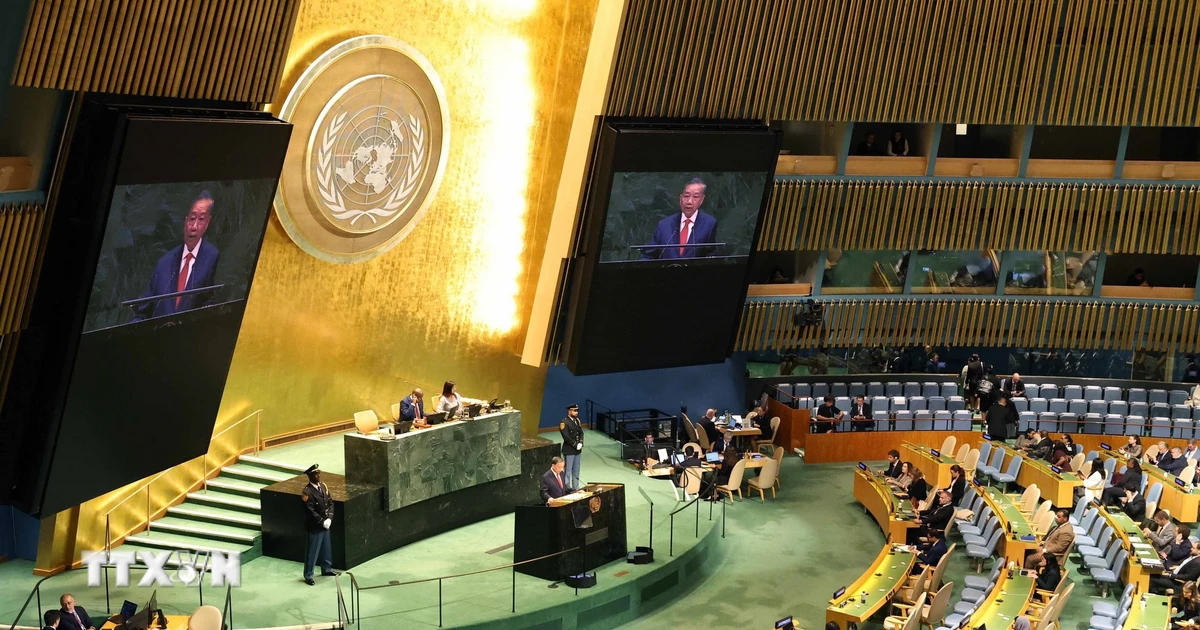
Within the framework of his business trip to attend the 81st session of the United Nations General Assembly and bilateral activities in the United States, on September 22 (local time), General Secretary and President To Lam delivered an important speech at the High-level General Debate at the United Nations headquarters in New York.
In his speech, General Secretary and President To Lam emphasized that science-technology, innovation, digital transformation, and artificial intelligence (AI) are opening up unprecedented opportunities while also posing new challenges.
Speaking with VNA reporters in Washington, Dr. David Ho, founder, Chairman, and Chief Scientific Officer of the biotechnology company HeMemics Biotechnologies Inc. in Maryland, stated that the assessment by General Secretary and President To Lam perfectly reflects the current global technological landscape.
According to him, for AI or digital transformation to achieve a breakthrough, a commensurate hardware foundation is required. Regarding opportunities, economies such as South Korea, Japan, or Taiwan (China) are focusing significant power on AI and hardware manufacturing, particularly traditional silicon chips. However, the physical limits of old technology are approaching. In his view, Vietnam's opportunity lies in penetrating the most fundamental layer, controlling chips and technology at the molecular level. Mastering 2D materials like Graphene is the foundation of next-generation science. By mastering technology at the molecular level, Vietnam can create a "leapfrog" to rise to a leading global position in the next generation of microchips and energy.
Regarding challenges, currently, only a very small group of countries in the world, such as the US, Japan, South Korea, and Spain, can produce Graphene. He believes that Vietnam must quickly grasp this technology to avoid dependence on major powers in the era of green energy and smart healthcare.
Regarding the statement by General Secretary and President To Lam that it is necessary to build inclusive, safe, transparent, and responsible governance principles and frameworks to ensure technology serves humanity while respecting national sovereignty, digital sovereignty, and the right to development autonomy, Dr. David Ho remarked that this is an extremely strategic vision, while emphasizing that "digital sovereignty" and "development autonomy" cannot exist without autonomy over the physical foundation of technology.
According to him, gaining control over 2D materials like Graphene will create an extremely unique and strategic position for Vietnam. With the ability to control materials at the molecular level, Vietnam will hold the "key" to initiating entirely new fields of innovation. A nation that masters Graphene will have a decisive voice in global technology governance frameworks, as it holds the essential materials for energy security (storage batteries, solar power) and health security (biosensors).
To prepare, Vietnam needs "sandbox" policies and breakthrough incentives to attract enterprises like HeMemics to bring these core technologies to the country, thereby establishing a position of autonomy and shaping the rules of the game on the international stage.
Dr. David Ho suggested: "To realize the vision of General Secretary and President To Lam and truly mitigate the risk of dependence, Vietnam cannot just import technology but must become a place that produces the foundation of that technology. The most breakthrough solution right now is to leverage the global trend of 'friend-shoring' - that is, shifting the core technology supply chain to safe, friendly allied and partner nations."
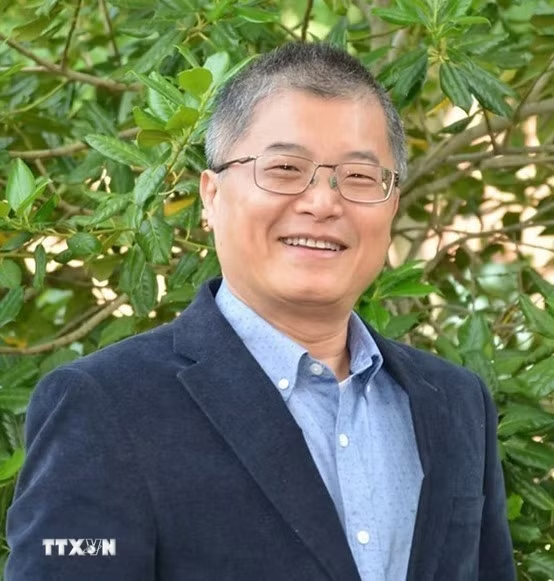
According to him, Vietnam needs to prioritize three specific policy groups.
First, immediately build experimental institutional frameworks (sandboxes) and special incentives specifically for Deep-tech projects and advanced materials like Graphene. We need to roll out the red carpet for companies capable of bringing molecular-level technology to industrial-scale production on Vietnamese territory.
Second, the State needs policies for co-financing or infrastructure support (land, procedures) to create a research and development (R&D) ecosystem around these high-tech manufacturing plants.
Third, proactively connect national policies with strategic investment funds of partner governments like the United States to attract development capital into hardware infrastructure production projects instead of focusing solely on software. When we hold the factories producing core materials for the world, the risk of external technological dependence will be automatically eliminated.
Regarding the method of combining international cooperation with domestic capacity development, Dr. David Ho emphasized bringing advanced core technology to Vietnam, scaling up production, and creating economic value.
Based on the foundations of policy, technology, and production, Dr. David Ho believes that Vietnam-US cooperation can open up opportunities in new technology fields, especially AI, new materials, biotechnology, and energy. He emphasized that the cooperation between Vietnam and the US in new technology is at a historic "golden moment," strongly driven by the US Government's policy of reducing dependence on risky supply chains and promoting "friend-shoring."
Addressing the global Graphene market, Dr. David Ho noted that most Graphene is still in raw, low-quality form and has not met the requirements of high-tech applications such as next-generation AI chips, sophisticated biosensors, or advanced energy batteries. According to him, this is the strategic gap that Vietnam and the US can fill together.
Seizing this opportunity, HeMemics has been working directly with the U.S. International Development Finance Corporation (DFC). He stated that the DFC is currently showing great interest in funding and partnering with the company to build a Graphene manufacturing plant in Khanh Hoa.
The strategic goal of this project is very clear: to bring high-tech production technology to Vietnam to manufacture Graphene with the highest purity, while achieving a breakthrough commercial price point. This will allow Vietnam, the US, and partner nations to have a stable supply of high-quality 2D materials for application in advanced products and R&D activities.

General Secretary and President To Lam speaks at the High-level General Debate of the 81st session of the United Nations General Assembly.
On September 22, 2026 (local time), at the United Nations Headquarters, New York (USA), General Secretary and President To Lam delivered an important speech at the High-level General Debate of the 81st session of the United Nations General Assembly.
(VNA/Vietnam+)
News in the same category

General Secretary and President To Lam attends a roundtable discussion with major U.S. enterprises.
24/09/2026 09:33
General Secretary and President To Lam proposes 3 pillars of cooperation with U.S. enterprises, in which both sides jointly develop science-technology, innovation, and enhance industrial competitiveness.
Giving opinions on the draft Law on amending and supplementing a number of articles of the Law on Intellectual Property.
24/09/2026 09:18
Continuing the 6th Session, on the morning of September 24, 2026, at the National Assembly House, the National Assembly Standing Committee gave opinions on the draft Law on amending and supplementing a number of articles of the Law on Intellectual Property; Considered and passed the draft Resolution on the protection regime for Judges.
Thường trực Ban Bí thư chủ trì Phiên họp lần thứ 5 Ban Chỉ đạo chuyển đổi số trong các cơ quan Đảng
24/09/2026 09:18
Sáng 24/9, tại Trụ sở Trung ương Đảng, đồng chí Trần Cẩm Tú, Ủy viên Bộ Chính trị, Thường trực Ban Bí thư, Trưởng Ban Chỉ đạo chuyển đổi số trong các cơ quan Đảng đã chủ trì Phiên họp lần thứ 5 của Ban Chỉ đạo.
Hội nghị thông qua dự thảo Báo cáo kết quả kiểm tra, giám sát đối với Ban Thường vụ Thành ủy Hải Phòng
24/09/2026 09:09
Sáng 24/9/2026, tại Hải Phòng, đồng chí Lê Minh Hưng, Ủy viên Bộ Chính trị, Bí thư Đảng ủy Chính phủ, Thủ tướng Chính phủ, Trưởng đoàn kiểm tra, giám sát số 222 của Bộ Chính trị đã chủ trì Hội nghị thông qua dự thảo báo cáo kết quả kiểm tra, giám sát (đợt 3) đối với Ban Thường vụ Thành ủy Hải Phòng.
Bài gốc còn tiếp — xem tiếp tại bài gốc ↗
Bài viết được AI dịch và tổng hợp tự động từ VietnamPlus Công nghệ. Liên kết bài gốc ở phía trên. AIHOT.vn luôn dẫn nguồn đầy đủ — nếu bạn thấy điểm cần chỉnh sửa, hãy gửi ý kiến tại trang phản hồi.