Tin ngành
Các đại gia công nghệ thúc đẩy G20 đầu tư trung tâm dữ liệu, nhưng lo ngại về rủi ro AI vẫn hiện hữu
(giờ Việt Nam)
Tóm tắt AI
Các tập đoàn công nghệ lớn kêu gọi G20 coi AI là hạ tầng thiết yếu để đẩy mạnh xây dựng trung tâm dữ liệu, bất chấp những tranh cãi về chi phí điện năng và tác động xã hội tại chính nước Mỹ.
Bản dịch AI

Top U.S. tech leaders are urging G20 nations to treat artificial intelligence (AI) as essential infrastructure and accelerate data center investments. However, even within the U.S., data center projects are facing community opposition due to concerns over electricity prices and social impacts…
Behind the race to develop AI lies an unprecedented race for infrastructure. As AI models increasingly demand more computing power, data centers, chips, and electricity have become the foundational elements of the digital economy. Yet, the rapid expansion of this infrastructure poses difficult questions for governments: how much to invest, how to control risks, and how to ensure local communities benefit rather than bear additional costs.
AI IS “INFRASTRUCTURE” LIKE ELECTRICITY, ROADS, AND THE INTERNET
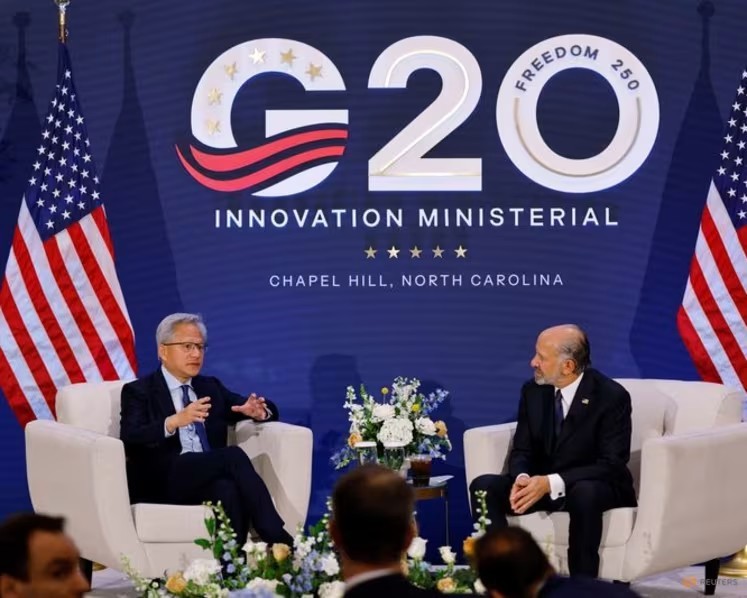
Leading U.S. tech executives, including Nvidia CEO Jensen Huang and OpenAI CEO Sam Altman, on September 2 called on G20 ministers to promote AI adoption and build the data center infrastructure necessary to power this technology.
These remarks were made on the second day of the G20 Summit in North Carolina, USA, where the administration of President Donald Trump gathered key figures from the AI industry to present their vision for the technology to ministers from the world's largest economies.
According to Jensen Huang, AI should be viewed as a form of basic infrastructure for the modern economy, similar to clean water, roads, electricity, and the Internet. “Ultimately, every country must realize that AI is infrastructure, just like water, roads, electricity, and the Internet,” the Nvidia CEO said. He argued that every nation needs to build its own AI infrastructure capacity to support its domestic economy.
Nvidia is currently a key player in the generative AI wave. The boom in this technology has helped Nvidia become one of the most valuable companies in the world.
Nvidia’s graphics processing units (GPUs) are widely used in data centers globally and play a critical role in training AI models.
According to Huang, data centers are not merely facilities for computation. They are also sources of “digital intelligence capacity” to support researchers, students, businesses, startups, and the entire economy.
However, the mass construction of data centers is sparking increasingly intense debate in the U.S. Many local communities are opposing new projects due to concerns that they consume massive amounts of electricity, putting pressure on the power grid and potentially driving up electricity costs for residents.
Against this backdrop, about 100-200 people gathered to protest at the University of North Carolina campus, where the G20 meeting was taking place, to oppose the rapid pace of AI development.
AI WILL NOT ELIMINATE JOBS, BUT THE RISKS ARE REAL
Beyond infrastructure, the impact of AI on employment was also a key topic of interest at the summit.
Huang dismissed the notion that AI would cause most jobs to disappear. “The idea that somehow all jobs will be eliminated or disappear is completely absurd,” he said.
According to the Nvidia CEO, AI will primarily change how work is organized. Some tasks will be automated, but the purpose and role of humans in work will remain.
“Tasks will be automated, but the purpose of work will remain,” Huang noted.
Notably, Huang argued that the biggest risk for nations is not that AI develops too quickly, but that they fail to leverage this technology and get left behind. “The worst outcome is that you don’t leverage it and get left behind,” he warned.

According to him, nations could suffer if leaders view AI primarily through a lens of fear and uncertainty.
This perspective reflects the tech industry's common approach: pushing for rapid AI adoption to capture economic benefits, while arguing that laggard nations risk losing their competitive advantage.
However, OpenAI CEO Sam Altman expressed a more cautious view regarding the risks of the technology.
Speaking at another discussion session, Altman suggested that it is not necessarily required for every country to build its own data centers. “Some countries will choose to build data centers. Others will choose to rent data centers from elsewhere because they don’t want to host them domestically,” he said, adding that both options are acceptable.
But according to him, the use of AI is non-negotiable. “This is not negotiable. You have to use it,” Altman said, comparing a country rejecting AI today to a country rejecting electricity a century ago.
“The value that AI brings to a nation is too great to ignore,” he emphasized.
Nevertheless, Altman acknowledged that concerns about AI are well-founded. “Worry is well-founded. Worry is how we anticipate and prepare for problems,” he said, drawing a parallel to the development of fire safety standards after fires once devastated many cities.
He also warned of the risk that AI could increase the concentration of wealth. OpenAI, according to him, does not want to be the only company in this field or “suck all the value” of the AI economy into itself.
FINDING THE “BALANCE” BETWEEN ACCELERATION AND CONTROL
While the tech sector emphasizes the economic benefits of AI, G20 ministers appeared more cautious.
UK Minister for Science and Technology Chris McDonald stated that no one denies the opportunities AI brings, but the government's responsibility differs from that of businesses. “Clearly, business leaders have a different set of responsibilities than those running nations,” he said.
According to McDonald, the UK is pursuing two goals simultaneously: accelerating AI development and maintaining public trust. Ignoring either factor could lead to negative consequences.
“There is no choice between protecting intellectual property and AI, or between economic growth and AI development. We must find the balance to achieve both,” he said.
He compared this approach to the “Goldilocks” story—not too hot, not too cold, but just right. “The porridge cannot be too hot or too cold. It must be just right, and that is a matter of judgment,” McDonald said.
The UK is not currently facing the same level of opposition to data center projects as the U.S. However, McDonald warned against assuming that community support will always be maintained.
He cited the British public's opposition to hydrogen projects and fracking as evidence that community attitudes can shift when technology and energy projects directly impact their lives.
“We must be very careful to ensure that the community is brought along on this journey,” he said. According to him, the goal is not to be a “missionary” for technology, but to approach AI in a practical and pragmatic way.
The debate at the G20 shows that the AI challenge is entering a new phase. As AI increasingly becomes a driver of economic growth, the demand for chips, energy, and data centers is also rising. But at the same time, the very physical infrastructure needed to develop AI is creating new problems regarding energy, the environment, costs, and social consensus.
Therefore, the challenge for governments is not just how to develop AI faster, but how to build an infrastructure ecosystem that is robust, controlled, and enjoys social consensus.
Bài viết được AI dịch và tổng hợp tự động từ VnEconomy Công nghệ & Startup. Liên kết bài gốc ở phía trên. AIHOT.vn luôn dẫn nguồn đầy đủ — nếu bạn thấy điểm cần chỉnh sửa, hãy gửi ý kiến tại trang phản hồi.