Hướng dẫn
Hướng dẫn lập trình với Jev từ TypeSafe AI: Ra quyết định kiểu dữ liệu, độ tin cậy và truy vấn song song
(giờ Việt Nam)
Tóm tắt AI
Bài viết hướng dẫn sử dụng Jev, mô hình System One đầu tiên của TypeSafe AI, tập trung vào việc trả về các kiểu dữ liệu Choice, Score và Noul để điều hướng logic chương trình thay vì tạo văn bản thông thường.
Chính văn · Bản dịch AI
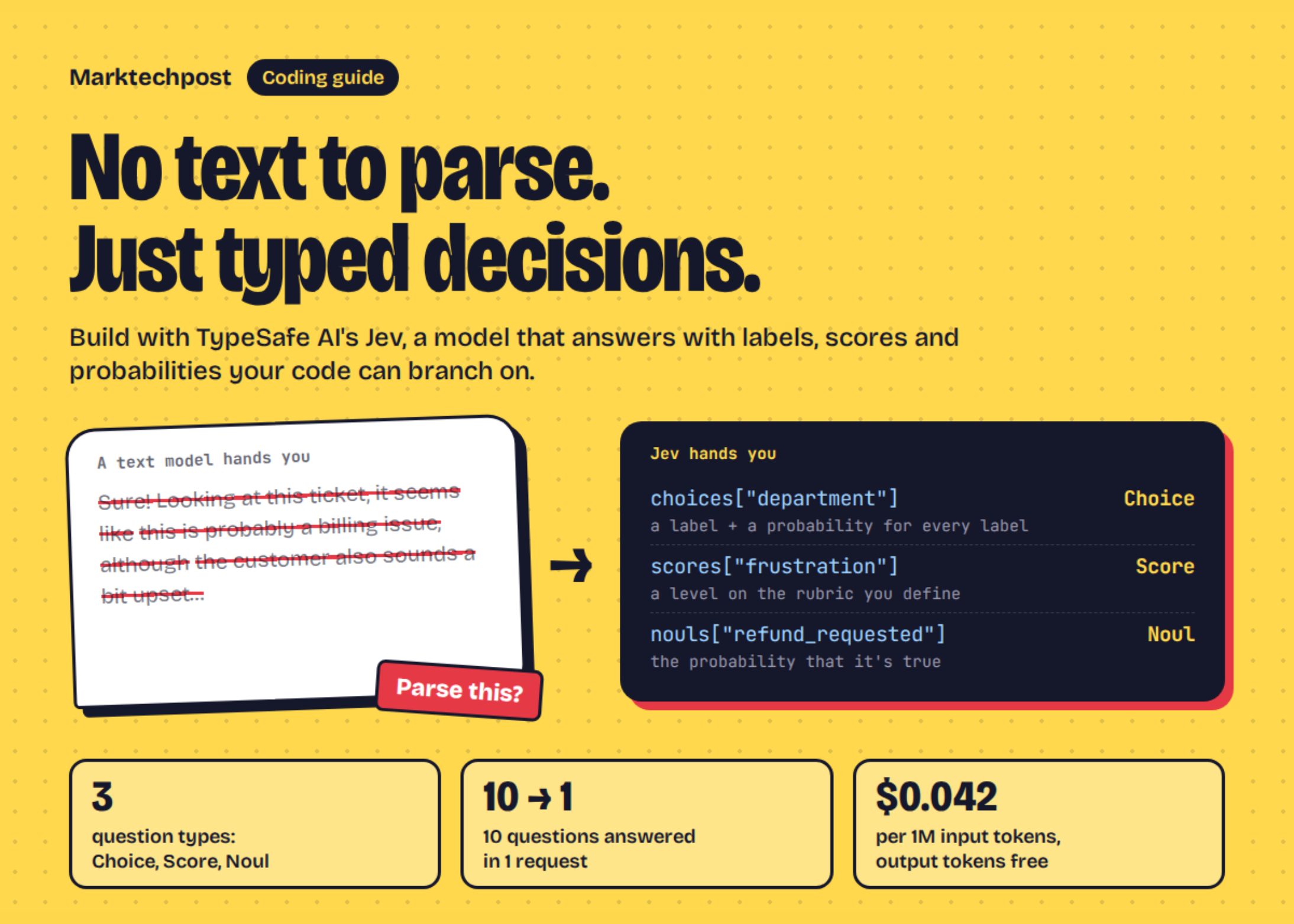
Trong bài hướng dẫn này, chúng ta sẽ làm việc với Jev, mô hình System One đầu tiên của TypeSafe AI, vốn không hề tạo ra văn bản: chúng ta gửi cho nó một phần trạng thái chương trình và một tập hợp các câu hỏi có kiểu dữ liệu, sau đó nó trả về các lựa chọn, điểm số và xác suất có/không để mã nguồn của chúng ta có thể phân nhánh trực tiếp dựa trên đó. Chúng ta cài đặt Python SDK chính thức, thực hiện lệnh gọi đầu tiên sử dụng đồng thời cả ba kiểu câu hỏi cơ bản và xem xét cách hình dạng của trạng thái thay đổi những gì mô hình có thể biết. Sau đó, chúng ta tính toán lại chỉ số tin cậy đã công bố từ các xác suất được trả về, đo lường lợi ích của việc gộp mười câu hỏi vào một lệnh gọi so với mười lệnh gọi riêng biệt, và xây dựng các mô hình mà API được thiết kế để hỗ trợ: định tuyến dựa trên độ tin cậy, chấm điểm tổng hợp với trọng số được lưu trong mã nguồn, gọi hàm có kiểu dữ liệu và đếm theo cách mà mô hình thực sự có thể thực hiện. Chúng ta kết thúc với cấu trúc sản phẩm: các mô hình phản hồi Pydantic, một client bất đồng bộ được triển khai với asyncio, các chính sách thử lại, lỗi có kiểu dữ liệu và một sổ cái theo dõi chi phí cho toàn bộ notebook.
import os
import sys
import json
import time
import asyncio
import traceback
import subprocess
from getpass import getpass

RESULTS = {}
LEDGER = {"calls": 0, "input_tokens": 0, "output_tokens": 0}
USD_PER_MILLION_INPUT_TOKENS = 0.042          # Jev list price; output tokens are free


def banner(title):
    print("\n" + "=" * 78)
    print(title)
    print("=" * 78)


def section(name):
    def wrap(fn):
        def run(*a, **kw):
            banner(name)
            try:
                out = fn(*a, **kw)
                RESULTS[name] = out if isinstance(out, str) else "ok"
                return out
            except Exception as e:
                RESULTS[name] = f"SKIPPED / FAILED -> {type(e).__name__}: {e}"
                print(f"\n[!] {name} did not complete: {type(e).__name__}: {e}")
                traceback.print_exc(limit=3)
                return None
        return run
    return wrap


banner("0. Install the SDK, load the API key, list the models")
subprocess.run([sys.executable, "-m", "pip", "install", "-q", "typesafe-sdk==0.7.0"], check=True)
import typesafe_sdk
from typesafe_sdk import Choice, Noul, Score, TypeSafeClient


def load_api_key():
    key = os.environ.get("TYPESAFE_API_KEY", "").strip()
    if not key:
        try:
            from google.colab import userdata          # Colab: key stored under the Secrets tab
            key = (userdata.get("TYPESAFE_API_KEY") or "").strip()
        except Exception:
            key = ""
    return key or getpass("TypeSafe API key (console.typesafe.ai/keys): ").strip()


os.environ["TYPESAFE_API_KEY"] = load_api_key()
client = TypeSafeClient()                              # reads TYPESAFE_API_KEY, defaults to jev-latest

print(f"  typesafe-sdk {typesafe_sdk.__version__}  |  Python {sys.version.split()[0]}")
print("  models available to this key:")
for m in client.models.list().models:
    print(f"    {m.name:<14s} released {m.release_date}   {m.description}")


def ask(state, questions, **kw):
    """One System One call, timed, with its tokens added to the running ledger."""
    t0 = time.perf_counter()
    response = client.system_one(state, questions, **kw)
    ms = (time.perf_counter() - t0) * 1e3
    LEDGER["calls"] += 1
    LEDGER["input_tokens"] += response.usage.input_tokens or 0
    LEDGER["output_tokens"] += response.usage.output_tokens or 0
    return response, ms
Chúng ta cài đặt typesafe-sdk, cố định ở phiên bản mà notebook này được viết, và tải khóa API từ môi trường, từ tab Secrets của Colab hoặc từ một lời nhắc ẩn để nó không bao giờ xuất hiện trong notebook. TypeSafeClient tự đọc TYPESAFE_API_KEY và mặc định sử dụng bí danh jev-latest; việc liệt kê các mô hình sẽ cho thấy những tên và phiên bản cố định nào mà khóa có thể sử dụng. Trình trợ giúp ask nhỏ gọn bao bọc system_one để mọi lệnh gọi trong phần còn lại của notebook đều được tính thời gian và mức sử dụng token của nó sẽ được ghi vào một sổ cái mà chúng ta tổng kết ở cuối.
TICKET = {
    "ticket": {
        "subject": "Duplicate charge",
        "messages": [
            {"from": "customer", "text": "I was charged twice for order A-104. This is the second time "
                                         "this year. Please refund the duplicate today."},
            {"from": "support", "text": "We are checking the charges."},
        ],
    },
    "order": {"id": "A-104", "charges": [{"amount_usd": 49, "status": "captured"},
                                         {"amount_usd": 49, "status": "captured"}]},
    "refund_policy": "Duplicate charges are eligible for a full refund within 30 days.",
}


@section("1. Three primitives, one call: Choice, Score, Noul")
def three_primitives():
    response, ms = ask(TICKET, {
        "department": Choice(
            instructions="Which team should handle this ticket",
            criteria={"billing": "Payment, refund or subscription issues",
                      "technical": "Bugs, outages or integration problems",
                      "sales": "Pricing, plans or account upgrades"},
        ),
        "frustration": Score(
            instructions="How frustrated the customer appears in `ticket.messages[0].text`",
            criteria=["Calm, just stating facts", "Frustrated but civil", "Very angry, strong language"],
        ),
        "refund_requested": Noul(instructions="The customer is explicitly asking for a refund"),
        "policy_supports": Noul(instructions="The stated `refund_policy` covers this situation"),
    })

    dept = response.choices["department"]
    print(f"  department       -> {dept.choice!r}   confidence {dept.confidence:.3f}")
    print(f"     probabilities    {({k: round(v, 3) for k, v in dept.probabilities.items()})}")
    fr = response.scores["frustration"]
    print(f"  frustration      -> score {fr.score:.3f} on 0..{len(fr.legend) - 1}   confidence {fr.confidence:.3f}")
    for level, text in fr.legend.items():
        print(f"     {level}: p={fr.probabilities[level]:.3f}  {text}")
    print(f"  refund_requested -> noul {response.nouls['refund_requested'].noul:.3f}")
    print(f"  policy_supports  -> noul {response.nouls['policy_supports'].noul:.3f}")
    print(f"\n  answered by {response.model} in {ms:.0f} ms   "
          f"input tokens {response.usage.input_tokens}, output tokens {response.usage.output_tokens}")
    return f"{dept.choice}, frustration {fr.score:.2f}, refund {response.nouls['refund_requested'].noul:.2f}"


three_primitives()
Một yêu cầu System One có hai phần: trạng thái (state), là bất kỳ văn bản, đối tượng JSON hoặc mảng nào mô tả tình huống, và một từ điển các câu hỏi được đặt tên. Choice chọn một nhãn từ các tiêu chí chúng ta xác định và trả về xác suất cho mỗi nhãn; Score đặt trạng thái vào một thang đo có thứ tự và trả về mức độ dựa trên trọng số xác suất, vì vậy nó có thể nằm giữa hai mức; Noul trả về một xác suất duy nhất cho biết một khẳng định là đúng. Tên các câu hỏi là do chúng ta đặt và không bao giờ truyền đến mô hình, đó là lý do tại sao các hướng dẫn mang đầy đủ ý nghĩa và có thể trỏ đến các trường lồng nhau bằng các đường dẫn trong dấu backtick. Cả bốn loại câu hỏi đều được đánh giá trong một yêu cầu, song song và độc lập với nhau, và phản hồi sẽ báo cáo phiên bản mô hình cố định đã trả lời cùng số lượng token đã tính phí.
@section("2. State is program state: the same question over a string and over named fields")
def state_shapes():
    question = {"eligible": Noul(
        instructions="The customer is eligible for a refund under the company's written policy",
        criteria={"true": "A policy is present and it covers the customer's situation",
                  "false": "No policy is given, or the policy does not cover the situation"},
    )}
    bare = "I was charged twice for order A-104. Please refund the duplicate."
    as_list = [m["text"] for m in TICKET["ticket"]["messages"]]
    shapes = [("string: the message only", bare),
              ("array : the conversation", as_list),
              ("object: ticket + order + policy", TICKET)]
    print(f"  {'state shape':<34s} {'noul':>6s}   input tokens      ms")
    seen = {}
    for label, state in shapes:
        response, ms = ask(state, question)
        seen[label] = response.nouls["eligible"].noul
        print(f"  {label:<34s} {seen[label]:6.3f}   {response.usage.input_tokens:12d}   {ms:5.0f}")
    print("\n  Only the object carries the policy and the two captured charges; the question")
    print("  is identical in all three calls, so any movement comes from the state.")
    return "noul by state shape: " + ", ".join(f"{v:.2f}" for v in seen.values())


state_shapes()
Trạng thái là thứ duy nhất mô hình biết, vì vậy chúng ta đặt một câu hỏi về việc liệu khách hàng có đủ điều kiện hoàn tiền theo chính sách bằng văn bản của công ty hay không, trên ba hình dạng trạng thái khác nhau. Một chuỗi văn bản thuần túy chỉ chứa khiếu nại; một mảng bổ sung thêm đoạn hội thoại; đối tượng JSON bổ sung thêm đơn hàng với hai khoản phí đã ghi nhận và chính sách hoàn tiền. Câu hỏi không bao giờ thay đổi, vì vậy bất kỳ sự khác biệt nào xuất hiện trong xác suất trả về đều là do trạng thái, và cột token cho thấy chi phí của ngữ cảnh bổ sung. Các trường được đặt tên là khuyến nghị được ghi lại bất cứ khi nào ngữ cảnh có nhiều phần, vì các hướng dẫn sau đó có thể tham chiếu đến chúng theo tên.
def confidence_from(probabilities):
    """TypeSafe's published statistic: (count x peak - 1) / (count - 1)."""
    p = list(probabilities.values())
    return (len(p) * max(p) - 1) / (len(p) - 1)


@section("3. Confidence is a statistic of the distribution, and you can recompute it")
def confidence_math():
    tone = Choice(instructions="What is the tone of the message",
                  criteria={"angry": "Upset or hostile", "calm": "Neutral or polite", "excited": "Enthusiastic or eager"})
    urgency = Score(instructions="How soon this needs attention",
                    criteria=["Can wait", "Needs attention this week", "Needs attention today"])
    messages = {
        "clear    ": "This is the third outage this week and nobody answers. Fix it NOW or I cancel today.",
        "ambiguous": "Well. That was certainly an experience. Let me know when you get a chance.",
    }
    print(f"  {'message':<10s} {'choice':<8s} {'API conf':>8s} {'recomputed':>11s}   "
          f"{'score':>6s} {'sum(level*p)':>13s} {'API conf':>9s}")
    worst = 1.0
    for label, text in messages.items():
        response, _ = ask(text, {"tone": tone, "urgency": urgency})
        t, u = response.choices["tone"], response.scores["urgency"]
        expected = sum(level * p for level, p in u.probabilities.items())
        print(f"  {label:<10s} {t.choice:<8s} {t.confidence:8.3f} {confidence_from(t.probabilities):11.3f}   "
              f"{u.score:6.3f} {expected:13.3f} {u.confidence:9.3f}")
        worst = min(worst, t.confidence)
    print("\n  A Noul has no confidence field: its value already is the probability of yes,")
    print("  so 0.5 means undecided, not medium.")
    return f"lowest tone confidence {worst:.2f}"


confidence_math()
TypeSafe ghi lại độ tin cậy (confidence) như một chỉ số được tính toán từ phân phối mà câu trả lời đã chứa sẵn: số lượng tùy chọn nhân với xác suất cao nhất, trừ đi một, chia cho số lượng tùy chọn trừ đi một. Chúng ta tính toán lại chỉ số này từ các xác suất của Choice và so sánh nó với trường confidence, đồng thời tính toán lại Score dưới dạng tổng của mỗi mức nhân với xác suất của nó. Việc chạy một thông điệp thẳng thắn và một thông điệp cố tình mơ hồ qua cùng hai câu hỏi cho thấy cách phân phối, và do đó là độ tin cậy, phản ứng với sự mơ hồ như thế nào. Một Noul không mang trường confidence nào cả, vì giá trị của nó vốn đã là xác suất của "có", và giá trị gần 0.5 có nghĩa là chưa quyết định thay vì ở mức trung bình.
POSTMORTEM = """Incident 2291 - checkout latency, 14 March. At 09:12 UTC the payments gateway began timing out
for roughly 18 percent of checkout requests in the EU region. The on-call engineer was paged at 09:15 and
acknowledged at 09:21. Initial suspicion fell on the new fraud-scoring service deployed the previous evening,
and it was rolled back at 09:40 with no improvement. At 10:05 the database team found that a connection pool
limit had been lowered from 400 to 40 by an automated configuration sync, which had silently overwritten a
manual override. The limit was restored at 10:11 and error rates returned to baseline by 10:19. Customer
impact: 3,420 failed checkouts and an estimated 61,000 USD in delayed revenue; no data was lost and no
customer data was exposed. Customers were not notified during the incident; the status page was updated at
10:30, after recovery. Follow-ups: alert on pool saturation, require review for configuration-sync overrides,
and add the status page update to the first fifteen minutes of the on-call checklist."""

FANOUT = {
    "root_cause": Choice(instructions="What was the root cause of the incident",
                         criteria={"bad_deploy": "A faulty code or service deployment",
                                   "config_change": "An incorrect configuration value",
                                   "capacity": "Organic traffic exceeded provisioned capacity",
                                   "third_party": "A failure at an external vendor",
                                   "unknown": "The text does not establish a cause"}),
    "detected_by": Choice(instructions="How the incident was first detected",
                          criteria={"alerting": "Automated monitoring or paging", "customer": "Customer reports",
                                    "employee": "An employee noticed by chance", "unclear": "Not stated"}),
    "severity": Score(instructions="Severity of customer impact",
                      criteria=["No customer-visible impact", "Minor degradation for a few customers",
                                "A core flow failed for a meaningful share of customers",
                                "Full outage of a core flow for most customers"]),
    "comms_quality": Score(instructions="Quality of customer communication during the incident",
                           criteria=["Customers were informed promptly while it was happening",
                                     "Customers were informed, but late",
                                     "Customers were only informed after recovery, or never"]),
    "data_exposed": Noul(instructions="Customer data was exposed or leaked"),
    "rollback_helped": Noul(instructions="Rolling back the fraud-scoring service resolved the incident"),
    "human_error": Noul(instructions="A person making a manual mistake directly caused the incident"),
    "has_followups": Noul(instructions="The text lists concrete follow-up actions"),
    "revenue_lost": Noul(instructions="Revenue was permanently lost, as opposed to delayed"),
    "eu_only": Noul(instructions="The impact was limited to the EU region"),
}


def value_of(answer):
    for field in ("choice", "score", "noul"):              # a score of 0.0 is a real value, not a miss
        if hasattr(answer, field):
            return getattr(answer, field)


@section("4. Speculative fan-out: ten questions in one call versus ten calls")
def fan_out():
    batched, batched_ms = ask({"postmortem": POSTMORTEM}, FANOUT)
    batched_tokens = batched.usage.input_tokens
    seq_ms, seq_tokens, agree = 0.0, 0, 0
    print(f"  {'question':<16s} {'one call':>10s} {'own call':>10s}")
    for name, q in FANOUT.items():
        single, ms = ask({"postmortem": POSTMORTEM}, {name: q})
        seq_ms, seq_tokens = seq_ms + ms, seq_tokens + single.usage.input_tokens
        a, b = value_of(batched.answers[name]), value_of(single.answers[name])
        same = a == b if isinstance(a, str) else abs(a - b) < 0.05
        agree += same
        fmt = (lambda v: f"{v:>10s}") if isinstance(a, str) else (lambda v: f"{v:10.3f}")
        print(f"  {name:<16s} {fmt(a)} {fmt(b)}   {'same' if same else 'differs'}")
    print(f"\n  one call : {batched_ms:7.0f} ms   {batched_tokens:6d} input tokens")
    print(f"  ten calls: {seq_ms:7.0f} ms   {seq_tokens:6d} input tokens")
    print(f"  -> {seq_ms / batched_ms:.1f}x faster and {seq_tokens / batched_tokens:.1f}x fewer tokens; "
          f"{agree}/{len(FANOUT)} answers agree, because questions never see each other")
    return f"{seq_ms / batched_ms:.1f}x faster, {seq_tokens / batched_tokens:.1f}x cheaper, {agree}/{len(FANOUT)} agree"


fan_out()
Vì các câu hỏi trong một yêu cầu không thể nhìn thấy nhau, chúng ta có thể hỏi mọi thứ mình cần ngay từ đầu, bao gồm cả những câu hỏi chỉ quan trọng ở một nhánh, và sau đó chỉ đọc các câu trả lời liên quan. Chúng ta đặt mười câu hỏi về việc phân tích sự cố sau khi xảy ra, gồm hai Choice, hai Score và sáu Noul vào một lệnh gọi, sau đó hỏi lại từng câu trong một lệnh gọi riêng biệt, rồi so sánh thời gian thực tế (wall time), token đầu vào và các câu trả lời. Trạng thái được gửi một lần thay vì mười lần, đây là nơi tiết kiệm được cả độ trễ và token, và cột đồng thuận kiểm tra trực tiếp tuyên bố về tính độc lập: một câu hỏi sẽ nhận được cùng một câu trả lời cho dù nó có đi kèm với các câu hỏi khác hay không.
INTENT = Choice(
    instructions="What the user wants the banking assistant to do",
    criteria={"check_balance": "See a balance or recent transactions",
              "approve_transfer": "Send or approve a transfer of money",
              "dispute_charge": "Contest a charge they do not recognise",
              "close_account": "Close the account permanently",
              "other": "Anything else, or not clear enough to act on"},
)
STAKES = {"check_balance": 0.50, "dispute_charge": 0.70, "approve_transfer": 0.85, "close_account": 0.90}


def route(answer):
    if answer.choice == "other" or answer.confidence < 0.50:
        return "-> human"
    bar = STAKES[answer.choice]
    return f"-> run {answer.choice}" if answer.confidence >= bar else f"-> confirm first (needs {bar:.2f})"


@section("5. Confidence-gated routing: the bar rises with the stakes")
def gated_routing():
    inbox = ["how much is in my checking account",
             "send 2,000 to my landlord like last month",
             "i guess maybe move some money around? not sure",
             "there's a 89.99 charge from a gym i never joined",
             "shut everything down, i'm done with this bank",
             "what's the weather like in lisbon"]
    print(f"  {'message':<50s} {'intent':<17s} {'conf':>5s}  decision")
    acted = 0
    for text in inbox:
        response, _ = ask(text, {"intent": INTENT})
        a = response.choices["intent"]
        decision = route(a)
        acted += decision.startswith("-> run")
        print(f"  {text[:50]:<50s} {a.choice:<17s} {a.confidence:5.2f}  {decision}")
    print(f"\n  thresholds live in code: {STAKES}")
    return f"{acted}/{len(inbox)} messages acted on automatically"


gated_routing()
Các câu trả lời có kiểu dữ liệu chỉ quan trọng nếu mã nguồn xung quanh chúng mã hóa mức độ chắc chắn cần thiết cho một hành động. Chúng ta phân loại mỗi tin nhắn thành một ý định và định tuyến dựa trên hai thứ: bản thân ý định đó và liệu độ tin cậy của nó có vượt qua ngưỡng tăng dần theo mức độ rủi ro hay không, từ 0.5 cho việc đọc số dư đến 0.9 cho việc đóng tài khoản. Bất cứ thứ gì được phân loại là "khác" hoặc dưới 0.5 sẽ được chuyển đến con người; một ý định được nhận diện nhưng dưới ngưỡng sẽ được xác nhận lại với người dùng trước. Các ngưỡng này là các giá trị Python thông thường, vì vậy khả năng chấp nhận rủi ro được xem xét, quản lý phiên bản và kiểm thử giống như bất kỳ mã nguồn nào khác thay vì bị chôn vùi trong một lời nhắc.
DIMENSIONS = {
    "python_depth": Score(instructions="Depth of hands-on Python engineering experience", criteria=[
        "No Python mentioned", "Scripts or notebooks only", "Ships production Python services",
        "Designs Python libraries or frameworks used by others"]),
    "ml_systems": Score(instructions="Experience running machine learning systems in production", criteria=[
        "None mentioned", "Trained models offline only", "Deployed and monitored models in production",
        "Owned large-scale training or serving infrastructure"]),
    "leadership": Score(instructions="Evidence of leading people or projects", criteria=[
        "None mentioned", "Mentored individuals", "Led a project or a small team",
        "Managed several teams or an organisation"]),
    "communication": Score(instructions="Evidence of clear written or public communication", criteria=[
        "None mentioned", "Internal docs only", "Public posts or talks", "Widely read writing or major conference talks"]),
}
CANDIDATES = {
    "Asha":  "Eight years of Python; maintains an open-source data validation library with 4k stars. "
             "Deployed fraud models at a bank and ran their monitoring. Mentors two juniors. Writes a technical blog.",
    "Bruno": "Engineering manager for three teams (22 people). Wrote Java for a decade, some Python scripting. "
             "Sponsored the company's ML platform but did not build it. Keynoted two industry conferences.",
    "Chen":  "PhD in statistics; trains models in notebooks, no production deployments. Python for analysis. "
             "Teaching assistant for two courses. Several internal reports.",
    "Dara":  "Built and owned the serving infrastructure for a recommender at 40k requests per second in Python "
             "and C++. Led a five-person platform team. Internal design docs only.",
}
WEIGHTS = {"senior IC": {"python_depth": .40, "ml_systems": .40, "leadership": .05, "communication": .15},
           "team lead": {"python_depth": .15, "ml_systems": .25, "leadership": .45, "communication": .15}}


@section("6. Composite scoring: atomic judgments from the model, weights from code")
def composite_scoring():
    table = {}
    for name, bio in CANDIDATES.items():
        response, _ = ask({"candidate_bio": bio}, DIMENSIONS)
        table[name] = {d: response.scores[d].score / (len(q.criteria) - 1) for d, q in DIMENSIONS.items()}
    print(f"  {'':<7s}" + "".join(f"{d:>15s}" for d in DIMENSIONS) + "   (each normalised to 0..1)")
    for name, row in table.items():
        print(f"  {name:<7s}" + "".join(f"{row[d]:15.2f}" for d in DIMENSIONS))
    winners = {}
    for role, w in WEIGHTS.items():
        ranked = sorted(table, key=lambda n: -sum(w[d] * table[n][d] for d in w))
        winners[role] = ranked[0]
        print(f"\n  ranking for {role:<10s}: " +
              "  >  ".join(f"{n} {sum(w[d] * table[n][d] for d in w):.2f}" for n in ranked))
    print("\n  Two rankings, four model calls: changing the weights re-ran no inference.")
    return ", ".join(f"{role}: {who}" for role, who in winners.items())


composite_scoring()
Chấm điểm tổng hợp giúp công việc của mô hình trở nên hẹp và chính sách trở nên rõ ràng. Với mỗi ứng viên, chúng ta đặt bốn câu hỏi Score, mỗi câu hỏi mô tả các tình huống cụ thể thay vì các mức độ, chuẩn hóa mọi điểm số theo mức cao nhất của nó và lưu trữ bảng kết quả. Việc xếp hạng sau đó chỉ là phép tính số học đơn giản: một vectơ trọng số cho một nhân viên đóng góp cá nhân cấp cao, một vectơ khác cho trưởng nhóm. Vì các đánh giá được lưu trữ tách biệt với trọng số, việc thay đổi những gì chúng ta coi trọng sẽ ngay lập tức xếp hạng lại các ứng viên mà không cần suy luận lại. Bạn có thể truy xuất mọi vị trí trong bảng xếp hạng về chiều dữ liệu đã tạo ra nó.
ROOMS = {"living_room": None, "bedroom": None, "kitchen": None, "office": None}


def set_lights(room, state):
    return f"lights in {room} -> {state}"


def set_thermostat(room, mode):
    return f"thermostat in {room} -> {mode}"


def play_music(room, genre):
    return f"playing {genre} in {room}"


TOOLS = {"set_lights": (set_lights, "state"), "set_thermostat": (set_thermostat, "mode"),
         "play_music": (play_music, "genre")}
CALL_SPEC = {
    "tool": Choice(instructions="Which smart-home function the command asks for",
                   criteria={"set_lights": "Turn lights on, off, or dim them",
                             "set_thermostat": "Make a room warmer, cooler, or set eco mode",
                             "play_music": "Play music or audio",
                             "none": "Not a smart-home command this system supports"}),
    "room": Choice(instructions="Which room the command refers to", criteria=ROOMS),
    "state": Choice(instructions="If this is a lights command: the requested light state",
                    criteria={"on": None, "off": None, "dim": None}),
    "mode": Choice(instructions="If this is a thermostat command: the requested mode",
                   criteria={"heat": "Warmer", "cool": "Cooler", "eco": "Energy saving"}),
    "genre": Choice(instructions="If this is a music command: the requested genre",
                    criteria={"jazz": None, "classical": None, "rock": None, "ambient": None}),
}


@section("7. Typed function calling, and counting the way Jev can do it")
def function_calling():
    commands = ["it's freezing in the office, warm it up", "kill the lights in the bedroom",
                "put on something mellow and jazzy in the kitchen", "order me a pizza"]
    dispatched = 0
    for text in commands:
        response, ms = ask(text, CALL_SPEC)                # every argument asked speculatively, one call
        c = response.choices
        tool = c["tool"].choice
        if tool == "none":
            print(f"  {text!r:<52s} -> no tool (confidence {c['tool'].confidence:.2f})")
            continue
        fn, arg = TOOLS[tool]
        weakest = min(c["tool"].confidence, c["room"].confidence, c[arg].confidence)
        print(f"  {text!r:<52s} -> {tool}(room={c['room'].choice!r}, {arg}={c[arg].choice!r})  "
              f"weakest judgment {weakest:.2f}, {ms:.0f} ms")
        print(f"  {'':<52s}    {fn(c['room'].choice, c[arg].choice)}")
        dispatched += 1

    basket = ["mango", "spanner", "kiwi", "router", "plum", "stapler", "fig", "lychee"]
    response, _ = ask({"items": basket},
                      {f"item_{i}": Noul(instructions=f"`items[{i}]` is the name of a fruit") for i in range(len(basket))})
    probs = [response.nouls[f"item_{i}"].noul for i in range(len(basket))]
    print("\n  counting: one Noul per item, summed in code (Jev does not count reliably in one question)")
    print("  " + "  ".join(f"{item}={p:.2f}" for item, p in zip(basket, probs)))
    count = sum(p > 0.5 for p in probs)
    print(f"  fruits counted: {count} of {len(basket)}")
    return f"{dispatched}/{len(commands)} commands dispatched from typed answers; counted {count} fruits"


function_calling()
Gọi hàm trở thành một tập hợp các câu hỏi tập đóng: một Choice chọn công cụ, bao gồm một tùy chọn "không" rõ ràng cho các lệnh mà chúng ta không hỗ trợ, và một Choice cho mỗi đối số được hỏi một cách suy đoán trong cùng một yêu cầu. Mã nguồn chỉ đọc các đối số thuộc về công cụ đã chọn, báo cáo đánh giá yếu nhất làm độ tin cậy của toàn bộ lệnh gọi, và sau đó thực thi một hàm Python thông thường với các giá trị đã được xác thực và liệt kê. Nửa sau áp dụng một giải pháp thay thế đã được ghi lại: Jev không đếm đáng tin cậy bên trong một câu hỏi duy nhất, vì vậy chúng ta hỏi một Noul cho mỗi mục trong một yêu cầu và thực hiện phép cộng trong mã nguồn.
import concurrent.futures
from typesafe_sdk import (AsyncTypeSafeClient, ChoiceAnswer, NoulAnswer, RetryPolicy, ScoreAnswer,
                          SystemOneResponse, TypeSafeAPIError, TypeSafeError)


class TicketDecision(SystemOneResponse):
    """Declare the answers you expect and read them as attributes, validated by Pydantic."""
    department: ChoiceAnswer
    frustration: ScoreAnswer
    refund_requested: NoulAnswer


TRIAGE = {
    "department": Choice(instructions="Which team should handle this ticket",
                         criteria={"billing": "Payment, refund or subscription issues",
                                   "technical": "Bugs, outages or integration problems",
                                   "sales": "Pricing, plans or account upgrades"}),
    "frustration": Score(instructions="How frustrated the customer appears",
                         criteria=["Calm, just stating facts", "Frustrated but civil", "Very angry, strong language"]),
    "refund_requested": Noul(instructions="The customer is explicitly asking for a refund"),
}
QUEUE = ["My invoice shows two seats but I only have one user.", "The export button does nothing in Safari.",
         "Can I get a discount if I pay annually?", "Your API returns 500 on every request since this morning!!",
         "I want my money back for last month, the product never worked.", "How do I add a teammate?",
         "Webhooks stopped firing after your update.", "Do you offer a plan for nonprofits?",
         "Charged after I cancelled. Refund this immediately.", "The dashboard is slow but usable.",
         "Is there an on-prem version?", "Login emails never arrive."]


def run_async(coro):
    """Works in a plain script and inside Jupyter/Colab, where an event loop is already running."""
    try:
        asyncio.get_running_loop()
    except RuntimeError:
        return asyncio.run(coro)
    with concurrent.futures.ThreadPoolExecutor(max_workers=1) as pool:
        return pool.submit(asyncio.run, coro).result()


async def triage_all(tickets):
    retry = RetryPolicy(max_retries=3, backoff_initial=0.5, backoff_max=4.0, timeout=20.0)
    async with AsyncTypeSafeClient(retry=retry, timeout=10.0) as aclient:
        t0 = time.perf_counter()
        results = await asyncio.gather(*(aclient.system_one(t, TRIAGE, response_model=TicketDecision)
                                         for t in tickets))
        return results, (time.perf_counter() - t0) * 1e3


@section("8. Production shape: typed response models, async fan-out, retries, errors")
def production():
    results, wall_ms = run_async(triage_all(QUEUE))
    for r in results:
        LEDGER["calls"] += 1
        LEDGER["input_tokens"] += r.usage.input_tokens or 0
        LEDGER["output_tokens"] += r.usage.output_tokens or 0
    print(f"  {len(QUEUE)} tickets triaged concurrently in {wall_ms:.0f} ms wall time "
          f"({wall_ms / len(QUEUE):.0f} ms per ticket amortised)\n")
    print(f"  {'ticket':<58s} {'department':<10s} {'frustr.':>7s} {'refund':>7s}")
    for text, r in zip(QUEUE, results):                    # attribute access, no dict lookups, no parsing
        print(f"  {text[:58]:<58s} {r.department.choice:<10s} {r.frustration.score:7.2f} {r.refund_requested.noul:7.2f}")

    print("\n  errors are typed too:")
    try:
        client.system_one("anything", {})
    except TypeSafeError as e:
        print(f"    empty questions, caught before any request : {type(e).__name__}: {e}")
    try:
        client.system_one("anything", {"q": Noul(instructions="Is this a test")}, model="jev-does-not-exist",
                          retry=RetryPolicy(max_retries=0))
    except TypeSafeAPIError as e:
        print(f"    unknown model, rejected by the API         : {type(e).__name__} (HTTP {e.status})")
    refunds = sum(r.refund_requested.noul > 0.5 for r in results)
    return f"{len(QUEUE)} tickets in {wall_ms:.0f} ms; {refunds} refund requests flagged"


production()
Bốn chi tiết biến các ví dụ thành một dịch vụ ra quyết định. Việc kế thừa SystemOneResponse và khai báo các câu trả lời mong đợi cung cấp quyền truy cập thuộc tính được xác thực bởi Pydantic, vì vậy quyết định có kiểu dữ liệu vẫn giữ nguyên kiểu dữ liệu đó xuyên suốt ứng dụng thay vì trở thành một tra cứu từ điển. Vì mỗi yêu cầu là độc lập, một hàng đợi các phiếu yêu cầu là một hàng đợi các quyết định độc lập: AsyncTypeSafeClient với asyncio.gather gửi chúng đồng thời, và trình trợ giúp run_async giúp cùng một mã nguồn hoạt động trong cả script và bên trong notebook, nơi một vòng lặp sự kiện đã đang chạy. RetryPolicy giới hạn số lần thử lại, thời gian chờ (backoff) và tổng ngân sách thời gian cho mỗi lệnh gọi. Các lỗi cũng được định kiểu: một tập hợp câu hỏi trống sẽ bị từ chối trước khi bất kỳ yêu cầu nào được thực hiện, và một tên mô hình không xác định sẽ được API trả về dưới dạng một lớp con TypeSafeAPIError mang theo trạng thái HTTP.
banner("SUMMARY")
for name, res in RESULTS.items():
    print(f"  {name:<86s} {res}")
cost = LEDGER["input_tokens"] / 1e6 * USD_PER_MILLION_INPUT_TOKENS
client.close()
print(f"\n  whole tutorial: {LEDGER['calls']} calls, {LEDGER['input_tokens']:,} input tokens, "
      f"{LEDGER['output_tokens']:,} output tokens (free)  ->  about ${cost:.5f}")
print("""
Where to go next
 - Patterns: docs.typesafe.ai/patterns  (fan-out, confidence routing, composite scoring, intent routing)
 - Cookbooks: re-ranking, RAG passage filtering, citation checks, LLM guardrails, hierarchical classification
 - Known rough edges of jev-1.13: docs.typesafe.ai/model-jaggedness/jev-1.13  (literal reading, arithmetic,
   counting, date comparison, large irrelevant state)
 - Compare against an LLM on the same questions: github.com/typesafe-ai/system-one-adapter-python
 - Pin a version for production: TypeSafeClient(model="jev-1.13.0"); response.model reports what answered
""")
Bản tóm tắt in ra kết quả một dòng mà mỗi phần trả về, sau đó tổng hợp sổ cái mà mọi lệnh gọi đã cung cấp: số lượng yêu cầu, số token đầu vào và đầu ra, cùng chi phí theo giá đầu vào đã công bố, với các token đầu ra được miễn phí.
Tóm lại, chúng tôi đã sử dụng Jev đúng theo cách nó được thiết kế: như một nguồn cung cấp các đánh giá nhỏ, có kiểu dữ liệu mà mã nguồn có thể tổng hợp, thay vì là một trình tạo văn bản cần phải nhắc lệnh (prompt) và phân tích cú pháp. Mọi câu trả lời đều được trả về dưới dạng nhãn, cấp độ hoặc xác suất kèm theo phân phối của nó, cho phép chúng tôi thiết lập các ngưỡng, trọng số và quy tắc định tuyến trong Python, nơi chúng có thể được kiểm thử. Việc xử lý theo lô các câu hỏi trên một trạng thái chia sẻ giúp giảm cả độ trễ lẫn số lượng token vì trạng thái chỉ truyền đi một lần cho mỗi mục; Nouls thay thế cho việc đếm mà mô hình không thể đảm bảo độ tin cậy, và các Lựa chọn (Choices) tập hợp đóng biến các lệnh ngôn ngữ tự nhiên thành các lệnh gọi hàm đã được xác thực. Các thành phần sản xuất, mô hình phản hồi có kiểu dữ liệu, trình khách bất đồng bộ (async client), chính sách thử lại và lỗi có kiểu dữ liệu đều rất nhỏ gọn, và sổ cái định giá cho toàn bộ notebook. Phần còn lại là việc mà không SDK nào có thể làm thay chúng ta: đánh giá các câu hỏi, tiêu chí và ngưỡng trên dữ liệu của chính mình trước khi tin tưởng giao cho chúng thực hiện các hành động thực tế.
Xem TOÀN BỘ MÃ NGUỒN tại đây. Mọi ghi nhận công lao thuộc về nhà nghiên cứu của dự án này. Ngoài ra, hãy thoải mái theo dõi chúng tôi trên Twitter và đừng quên tham gia SubReddit 150k+ ML của chúng tôi cũng như Đăng ký Bản tin của chúng tôi. Khoan đã! Bạn có dùng Telegram không? bây giờ bạn cũng có thể tham gia cùng chúng tôi trên Telegram.
Bạn cần hợp tác với chúng tôi để quảng bá GitHub Repo, Trang Hugging Face, Ra mắt sản phẩm hoặc Hội thảo trực tuyến, v.v. của bạn? Kết nối với chúng tôi

Asif Razzaq
Asif Razzaq là CEO của Marktechpost AI Media Inc.. Là một doanh nhân và kỹ sư có tầm nhìn, Asif cam kết khai thác tiềm năng của Trí tuệ nhân tạo vì lợi ích xã hội. Nỗ lực gần đây nhất của ông là ra mắt Nền tảng Truyền thông Trí tuệ nhân tạo, Marktechpost, nổi bật với việc đưa tin chuyên sâu về tin tức học máy và học sâu, vừa đảm bảo tính kỹ thuật vừa dễ hiểu đối với đông đảo khán giả. Nền tảng này tự hào với hơn 2 triệu lượt xem hàng tháng, minh chứng cho sự phổ biến của nó đối với độc giả.
Bài viết được AI dịch và tổng hợp tự động từ MarkTechPost. Liên kết bài gốc ở phía trên. Dữ liệu đồng bộ qua API công khai được ghi nguồn tại AI HOT (canonical) ↗. AIHOT.vn luôn dẫn nguồn đầy đủ — nếu bạn thấy điểm cần chỉnh sửa, hãy gửi ý kiến tại trang phản hồi.